The number of traders that fail a prop firm challenge is around 90% and that number drops to only a 35 pass rate on the first try.
So why would you even try? We will argue that it is worth trying as the gap between failure and success isn't about trading talent, it's about understanding why challenges are structured to eliminate undisciplined traders and adapting accordingly.
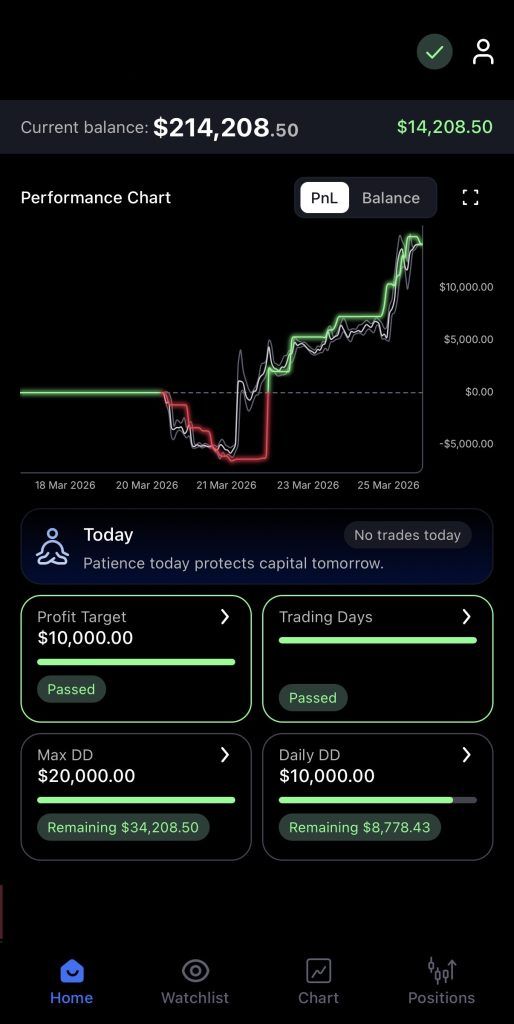
Skip the failure patterns and get to that Passed Challenge Screen
Most traders who fail aren't terrible at reading charts or spotting setups. They fail because they treat prop firm challenges like regular trading when the rules are fundamentally different. Plus, lack of attention to detail.
If you're considering a challenge or have failed one before, understanding these failure patterns could be the difference between getting funded and wasting another challenge purchase fee.
If you're just starting out read our prop firm trading full guide.
Why The Failure Rate in Prop Trading Is So High (And Why It's By Design)
Prop firms aren't an academy meant to upskill you and give you money. Challenge rules exist to filter out traders who can't handle institutional capital responsibly. The strict daily drawdown limits, maximum total drawdown caps, and profit targets with strict risk management aren't arbitrary.
How many traders have made it, only to lose it all? How many times have you been up big before that liquidation email?
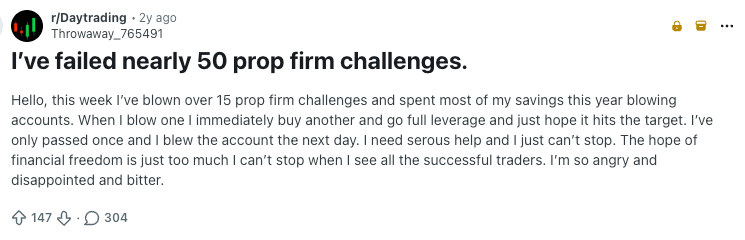
Sorce: Reddit
They're meant to test whether you can trade like a professional for weeks or months, not just get lucky for a few days.
When you're trading your own capital, you can be flexible with risk. You can take a 15% drawdown and trade your way back...hopefully. With prop firms, one violation ends your account permanently, even if you're profitable overall. You must adapt to the challenge you choose.
The 7 Biggest Reasons Traders Fail Challenges
1. They Don’t Read or Understand the Rules of the Prop Challenge
With so many trading related factors to passing a prop firm challenge we’re boldly throwing “did not read or understand the rules” as the #1 reason prop traders fail their challenges. If not the most prevalent, it’s the easiest to fix.
One of the most frequent questions we get by users is “why did I fail this challenge???” They simply did not take everything in account. Rules can be simple or complex or they might change. Some are specific to prop firms.
If you must set a Stop Loss, how long do you have to set it? What if you’re changing the Stop Loss?
Are you sure you know what the daily drawdown reset time is? Is it trailing?
Solution: Read the rules, got through the FAQs, check the prop firm’s Discord or Telegram, confirm what you’re not 100% sure you understand.
If possible use a prop trading platform that clearly states the prop trading rules.
If there’s a trial, do the trial. This is not a waste of time; you need to have all the mission intel before you go on it.
This is our general guide on prop firm rules and how to stay on top of them.
2. Poor Risk Management - The #1 Killer in Crypto Prop Trading
Risk management failure is responsible for more blown challenges than any other factor. Traders commonly make these mistakes:
Risking too much per trade. Many traders risk 2-3% per trade thinking it's conservative. Under prop firm rules with 5% daily and 10% total drawdown limits, this is suicide. Three consecutive losses at 2.5% risk each puts you at -7.5% and in some cases you've just violated the total drawdown and lost your account.
Don't forget how volatile crypto markets can be, this adds fuel to the fire.
The math of recovery works against aggressive risk as well: a 10% loss requires an 11.1% gain to break even. A 30% drawdown demands a 42.9% return. Prop firms know this, which is why they cap your losses tightly.
Solution: Risk no more than 0.5-1% per trade during challenges. With a 10% drawdown limit, this is a whopping 5%-10%. This allows you to survive losing streaks while staying well within drawdown limits. If your historical maximum losing streak is 10 trades, use 0.5% risk. If it's 5 trades, 1% might work. Base your risk on your actual trading data, not what feels right.
3. Not Understanding Drawdown Rules (The Hidden Killer)
The first culprit is this is not understanding the difference between balance and equity and how prop firms work with them when it comes to drawdown.
Drawdown rules vary significantly between prop firms, and many traders don't fully grasp the difference between absolute and relative drawdown.
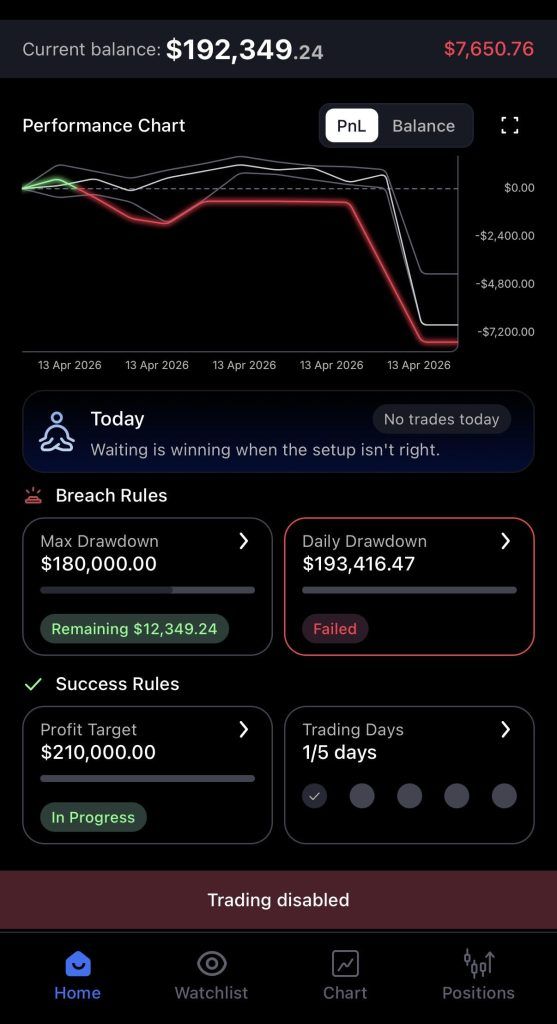
Absolute drawdown is measured from your starting balance. If you start with $100,000 and the max drawdown is 10%, you cannot drop below $90,000 ever.
Relative or trailing drawdown is measured from your highest account balance or often equity. If you grow your $100,000 account to $105,000, and the max drawdown is 10%, you cannot drop below $94,500 ($105,000 - $10,500). Your "floor" keeps rising as you profit, so you have less wiggle room on a bigger account.
The real kicker is this is often done through equity. Even if you never close any positions your max equity may keep growing. So, you may have a profitable day and still trigger a daily drawdown breach:
You start with $10,000 at 5% daily drawdown.
- You have the best luck and grow that account equity to $10700 in open PnL
- Positions reverse; you’re still in profit but equity dips for a second below $10,165
- You’re breached even if open profit goes up immediately after that
Those 5% can come at you fast and you can end up losing your account on a profitable day.
This single misunderstanding has cost traders thousands in wasted fees.
Solution: Go back to all advice from #1 and #2.
Deep dive into drawdown rules before you do anything else.
4. Overtrading and Rushing Boost the Chance You'll Get Breached
The profit target combined with trading day constraints create intense psychological pressure. Traders feel they need to "make it" quickly, leading to overtrading without proper setups.
Here's what typically happens: You take one or two quality trades, then start watching charts obsessively. You see marginal setups and think, "Maybe I can squeeze in one more win to reach the target faster." You enter without strong confirmation, and losses accumulate.
Overtrading leads to:
- Taking low-probability setups outside your strategy
- Increased commission costs that eat into profits (a humongous, underrated point)
- Mental fatigue causing poor decision-making
- Revenge trading after losses (don’t underestimate this classic in prop or independent trading)
The worst is when you’re so case to hitting that profit target that you start to take dumb positions, causing heightened risk over a 0.1% gain.
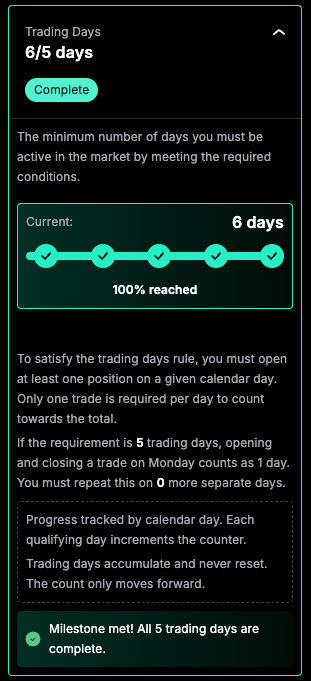
No need to rush in passing your crypto prop challenge
Very few crypto prop firms today have a time limit on passing challenges, in fact they have rules for spreading out your trading. Don’t let your ego and bragging right over how fast you passed your challenge steal your account.
Solution: Focus on quality over quantity. Prop firms reward consistent profitability, not activity. Set a maximum number of trades per day based on your strategy's historical average. If you typically take 1-2 high-quality setups daily, don't suddenly start taking 5-7 trades because you're in a challenge.
5. Lack of a Trading Plan
This is another classic in trading in general and there’s 2 parts to it: the plan and sticking to it.
You cannot pass a prop firm challenge by "winging it" or trading by feel. Without a documented plan, you'll make inconsistent decisions, react emotionally to market moves, and have no framework for self-correction.
Your trading plan must define:
- Strategy specifics: What exact conditions trigger entries? What indicators, patterns, or price action signals do you use?
- Entry and exit rules: When do you enter positions? Where do you place take-profit and stop-loss orders?
- Risk parameters: How much do you risk per trade? What's your daily loss limit (set way below the firm's maximum)?
- Position management: Do you scale in/out? Can you move targets or protections?
- Trading schedule: Which sessions do you trade? How many hours daily?
Now most traders that spend money on a challenge have some plan, but sticking to it? That discipline can come only from experience. Trials are a great way to gain some without blowing up numerous accounts.
Backtesting is another confidence building mammoth, and more traders skip it than do it
Your backtesting results are the core of your trading business and only if strong you can start thinking about investing in it.
Solution: Write your complete trading plan before starting the challenge. Test it extensively on demo accounts under simulated challenge conditions. Your plan should be detailed enough that another trader could execute your strategy by reading it.
Here’s how you can construct a strategy that fits prop firm rules.
6. Not Understanding Trading Fees, Commissions and Slippage
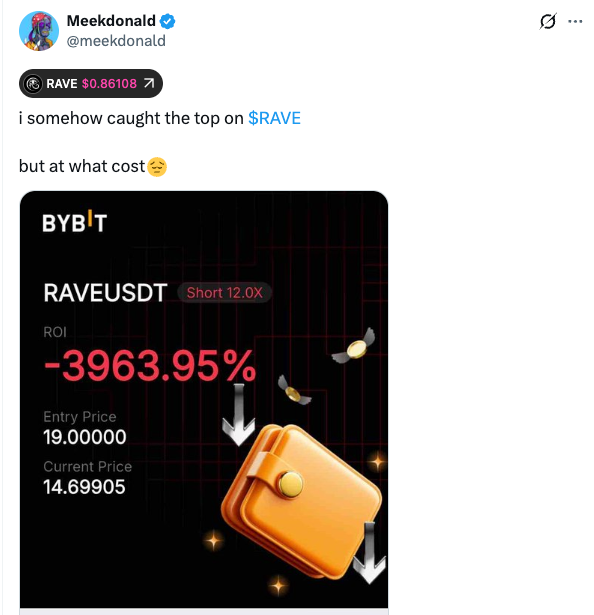
Opening, holding and closing positions on futures is expensive. Funding can be tricky, and the outliers can destroy your PnL even on a good setp.
Fees can be brutal if you trade with tight Stop Losses and Take Profits.
Slippage is among the biggest thieves, especially in volatile conditions on less liquid assets, yet these volatile conditions are often the most popular.
Trading costs are quick to punish overtrades, so carefully selecting setups goes a long way.
Source: X
Exchanges don’t always show total costs either but bury them in the PnL, so novice traders are not aware of the dent they’re causing in their results.
Solution: Take note of your trading costs in the preparation phase. Slippage is unpredictable so when creating a setup save off some profit in the projection for it.
If volatility is what you’re after stick to Bitcoin and majors.
Lastly make sure that your exchange and platform are showing you the numbers as they are, instead of a lack of transparency many are complacent with.
This is what trading cost level of detail you should aim for.
7. Using the Wrong Tools for Prop Trading
Standard exchange interfaces aren't built for the precise risk control that prop challenges demand. When you're operating within 1% daily drawdown margins, every move matters. Manual position sizing calculations, imprecise order entry, and unclear risk visualization create unnecessary failure points.
Prop firm trading requires tools that:
- Always show you exactly where you are in respect to the challenge rules
- Calculate position sizes automatically based on risk percentage
- Display pre-trade risk/reward clearly before order execution
- Enable precise stop-loss and take-profit placement
- Give you performance statistics
- Allow for more complex risk management through multiple TPs and SLs
Trading on platforms that lack these features puts you at a competitive disadvantage. You're fighting both the market and your own tools.
Solution: Use platforms specifically designed for prop firm traders. The CLEO Prop Trading Platform was built to address exactly these challenges, offering visual trading interfaces, pre-calculated risk-reward ratios, multiple stop-loss and take-profit levels, and integrated position management, all designed to help you stay within prop firm rules while executing your strategy effectively.
This is not a shameless plug, you simply need the right tool for the job and crypto prop traders are the most underserved category in trading. So much so that many cannot imagine an app where they can execute through customizable Quick Actions, track their challenge and get performance statistics. They’re so used to switching tabs and conducting their trading on interfaces designed for buy & hold.
The CLEO Prop Trading Platform is available via Mubite, HyroTrader, Klein Funding and Prop Funded
The right tools can be a real edge in a competitive, detail oriented industry, such a crypto prop trading.