
Crypto prop traders rarely fail because they don’t understand the market. Most fail because they misunderstand the rules under which they’re trading when taking a challenge. Understand the rules well and you’ll be much closer to that first payout certificate.

If you trade with firms like HyroTrader, Mubite, Breakout, or similar, your evaluation and funded account are governed by strict risk constraints like daily drawdown, max loss, total drawdown, and consistency rules. These rules are typically enforced using equity, meaning all your open positions count immediately.
In fact, learning how to think predominantly in equity is a massive factor when transitioning to prop firm trading.
This guide explains the most important crypto prop firm rules in 2026, shows how they are calculated, and suggests prop-safe frameworks to avoid violations though caution.
Prop Firm Rules Cheat Sheet
If you want to pass and stay funded, these rules matter most:
- Daily drawdown is the most common failure criteria
- Max loss (total drawdown) ends the account
- Equity-based limits mean open losses count immediately
- Trailing drawdown punishes volatile equity curves
- Consistency rules punish one big day passing attempts (and are quite frustrating for some)
- Stop-loss discipline is basic survival, even when not explicitly required
- Trading days should be used for intelligent decisions not fulfilling a quota
- Restrictions and prohibited strategies can invalidate your results
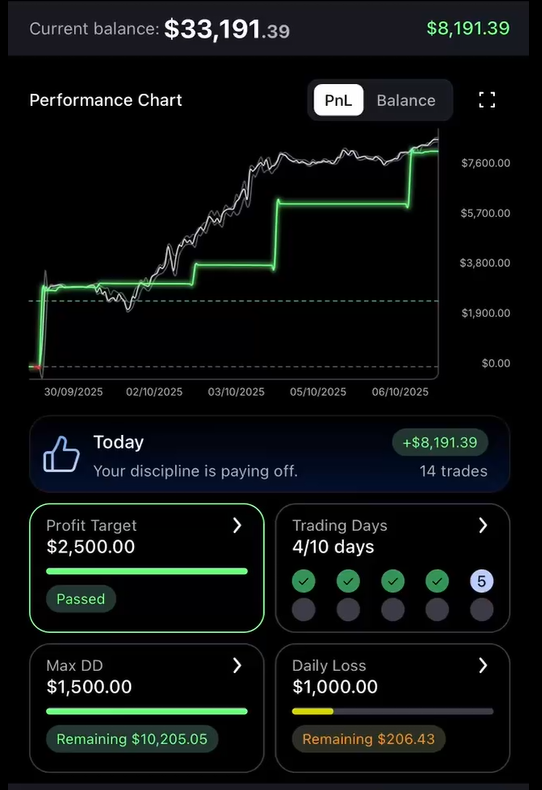
Despite sounding dramatic in the introduction, sticking with some basic principles will have you safe with a decent strategy. However it requires patience, and that’s easier said than done. If you want a simple prop-safe framework that fits most crypto prop environments:
- Risk 0.25% to 0.5% per trade
- Reserve 5% for A+ setups only if you need to fulfill minimum trading days
- Stop trading for the day after 1 to 2 losses
- Trade 1 to 3 high-quality setups per day
- Avoid low-liquidity assets and high-volatility sessions
- Use an execution workflow that makes stop placement and risk monitoring automatic
This last point matters because most breaches happen under pressure. Error is a big factor in failing prop firm challenges. Execution errors get punished immediately in prop trading.
Basic Rules Glossary (Make sure you understand each, you’d be surprised how many traders don’t)
Equity: Balance plus open profit and loss
Balance: Closed profit and loss only
Daily drawdown: Maximum allowed loss in one day
Max loss / total drawdown: Maximum allowed total loss on the account
Static drawdown: Drawdown floor is fixed relative to starting balance.
Trailing drawdown: Drawdown floor rises as equity reaches new highs
Consistency rule: More than X% of profit target cannot come from one position
Minimum trading days: Required number of trading days before passing – they usually have a set % of account balance that needs to be used in trades
Restrictions: Limits on news trading (more legacy markets based), leverage, or trading pairs
Prohibited strategies: Banned tactics like martingale, grid, latency exploitation, and certain arbitrage styles
1) The 7 Rule Categories in Crypto Prop Firms
Crypto prop firm rules vary in details, but they almost always fall into these categories:
Rule Category | What it controls | Common failure reason
Daily drawdown | max daily loss | overtrading, volatility spikes
Max loss / total drawdown | total loss allowed | slow bleed, one big mistake
Drawdown type | static vs trailing | trailing floors sometimes trap traders
Stop-loss discipline | risk control | delayed stops, mis-sizing
Consistency | profit distribution, minimum trading days | one big day, size spikes
Restrictions | what you can trade | small market caps
Prohibited strategies | behavior rules | martingale, grid, exploitation
Your job is to build a strategy and risk process that survives inside these constraints and stick to it religiously. If your strategy requires frequent large drawdowns or variable sizing, it will clash with prop rules.
If you have no idea if your strategy fulfills these criteria drop everything and get that data through backtesting or forward testing. Otherwise, you’re just donating to prop firms.
2) Equity vs Balance (The key mechanic that changes everything)
In crypto prop challenges, drawdowns are always enforced using equity, not balance. The mindset of “it’s not a loss unless you close it” doesn’t belong anywhere near crypto prop trading.
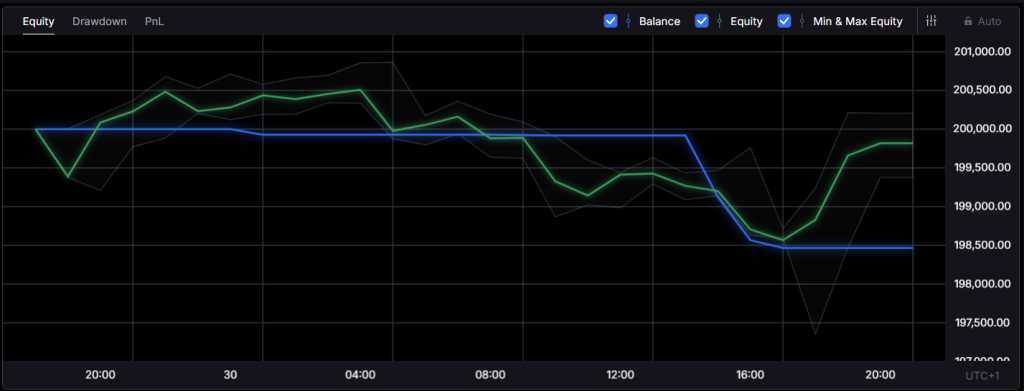
Balance and equity can move quite differently
That means:
- open trades count immediately
- open losses reduce your available drawdown room
- you can breach intraday even if the trade later reverses
- execution mistakes matter more than they do in a personal account
- you can’t add more margin to save your account
This is one reason prop trading is fundamentally different from normal trading. You cannot rely on “it will reverse any second now.” Your risk must be correct before you enter the trade.
This also explains why experienced prop traders build workflows that support fast monitoring and de-risking. Desktop execution for precision entries and position management, and mobile monitoring for quick risk checks and emergency reductions, is a common solid setup. It reduces the chance of violating limits due to delayed action.
Use of presets for Stop Losses and Take Profits and position sizing is also common. To do that you first need to know the optimal levels. Again, if you don’t drop everything and get to backtesting.
3) Daily Drawdown Rule Explained (3%,4% and 5% Limits)
The daily drawdown rule is a cap on how much you can peak in losses during the day. If you hit it, you usually fail the evaluation or lose the funded account. Does not matter if you never close those losing positions, they count.
Check out this simple explination of daily drawdown if you're just starting out.
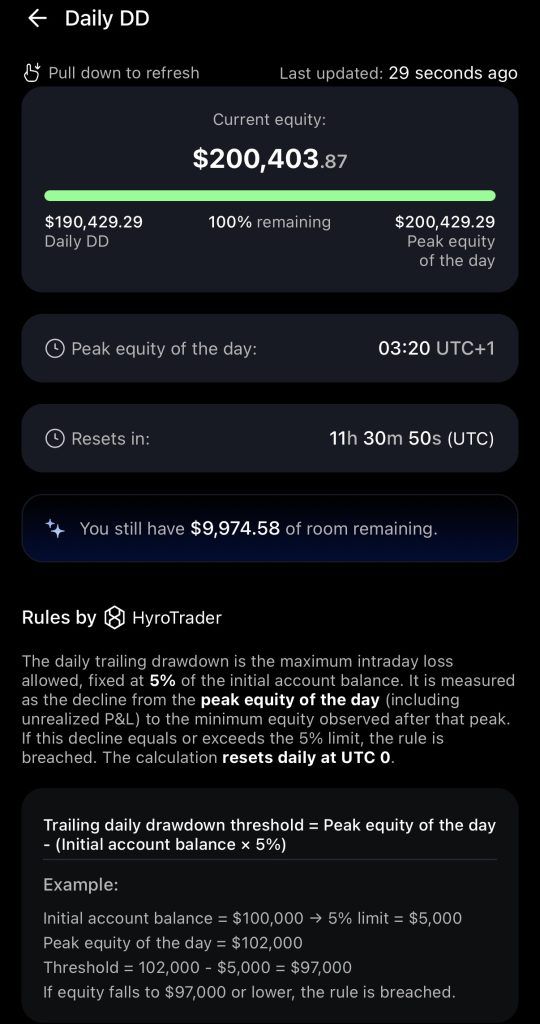
Daily drawdown rules and progress explained in detail on the specific challenge
Daily drawdown is one of the most common failure criteria because crypto volatility can move very quickly, and equity-based enforcement counts open losses.
What traders usually misunderstand
- Daily DD is often enforced intraday
- It is based on equity, not balance
- The daily baseline can be start-of-day balance, start-of-day equity, or peak equity. This shifts with different types of challenges
- Slippage can push you past the limit even if you planned the trade correctly
Prop-safe guideline (simple and effective)
If the firm daily drawdown is 5%, your barrier can be a personal daily stop that should be smaller than that. That way slippage has less of a chance to get you and you’re keeping some margin open.
A good guideline is to stop at 40% to 60% of the firm’s limit.
Firm Daily DD | Personal stop (recommended)
5% | 2% to 3%
4% | 1.5% to 2.5%
3% | 1% to 2%
This gives you a buffer for execution imperfections and emotional reactions after losses.
To understand why firms implement this rule you need to understand risk of ruin.
4) Max Loss vs Max Drawdown vs Total Drawdown
These terms are often used inconsistently across firms, but the practical meaning is usually the same: the total amount you must have in balance and open trades before the account is breached.
The key question is how it is calculated:
- Is it based on starting balance (static)?
- Is it based on peak equity (trailing)?
- Is it enforced on equity or balance?
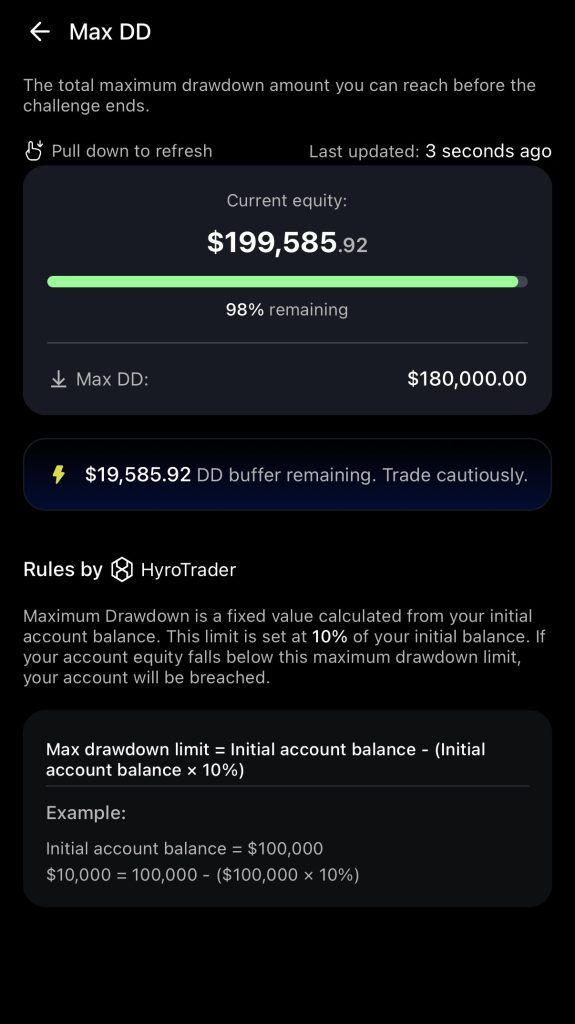
Max drawdown with details and progress
Practical interpretation table
Term | What it usually means | What you must verify
Max loss | total loss allowed | baseline: start vs peak
Max drawdown | total loss allowed | static vs trailing
Total drawdown | total loss allowed | definition and baseline
Equity limit | breach on equity | intraday enforcement
Why max loss ends accounts
Most accounts do not fail because of one massive mistake. They fail because:
- small losses accumulate
- slippage increases loss sizes
- traders continue after early losses
- discipline degrades over time
5) Trailing Drawdown vs Static Drawdown
Drawdown type is not a detail. It changes which strategies are compatible.
Static drawdown
Static drawdown is calculated from the starting balance and does not move up as you profit. This is more predictable and easier to manage. If your starting account is $10,000 and you’re allowed 10% max drawdown your account cannot drop below $9,000. Does not matter what you make.
Trailing drawdown
Trailing drawdown rises as your equity hits new highs. If it’s trailing and you start with $10,000 and you make $1,000 your floor is no longer $9,000, but $9,900. 10% of the new value of the account $11,000.
This can trap traders because the drawdown floor increases as you succeed and progress with your challenge.
Trailing drawdown punishes:
- volatile equity curves
- aggressive scaling after wins
- strategies with deep pullbacks
- high-frequency entries during volatility
Prop-safe approach: In trailing environments, prioritize smoother equity curves and lower risk per trade.
6) Stop Loss Risk and Why It Becomes a Rule Even When It Is Not Written
Many traders are surprised by the “stop-loss rule” in prop firm documentation. Some firms explicitly require stops. Others do not. In practice, stop-loss discipline becomes a rule because of how equity limits and consistency constraints work. Not to mention that at the end of the day you’re after funding. If you can’t be disciplined with a stop loss you can’t replicate your performance in the long run and you surely cannot expect anyone to fund you.
Note that the use of stop loss often has other conditions attached to it by crypto prop firms, like what % of the account can be risked on one, for example 3%.
Without strict stops:
- daily DD is hit unexpectedly
- max loss is breached in a single volatile move
- equity-based enforcement triggers violations instantly
- losses become unpredictable, which also harms consistency metrics
A prop-safe stop-loss principle:
- risk per trade is fixed (0.25% to 0.5%)
- stop is placed immediately
- stop is based on a clear invalidation point
- you do not widen stops to avoid being wrong
- if you need more space in the trade use multiple predetermined stop losses
This is where execution workflow matters. Traders breach rules when stop placement and sizing are improvised under pressure. A professional execution setup, especially one that supports consistent order placement on desktop with presets and quick monitoring on mobile, reduces these errors. Let’s face it most of the time when it comes to stop losses you have the plan you just execute it badly. CLEO’s desktop terminal and mobile app are designed for that kind of live trading workflow: consistent order execution, clear position monitoring, and faster risk management across devices.
7) Consistency Rule Explained (How It Works and What Passes)
Consistency rules exist to prevent traders from passing by luck or extreme leverage. They reward stable behavior and controlled risk. They can be frustrating though.
Imagine it’s one of those days in crypto volatility when your fills are excellent and you’re in a position on a trending pair and you know your profit is far from done. Well, if you were trading a prop firm challenge this is when you’d check your profit target and consistency rule. What you make might not count.
The most common types:
- Maximum daily profit percentage – one day’s profit can make only a certain % of your profit target
- Maximum profit from a single trade - one trade can make only a certain % of your profit target
- Consistency score based on equity curve smoothness – this is more typical in legacy markets, but an interesting concept if you’re looking to improve your equity curve
Consistency rules often fail traders who:
- attempt to finish a target in one day
- increase size after losses
- take a single high-leverage trade for the final push
The simplest way to pass consistency rules is again to make your performance boring:
- fixed risk per trade
- fixed trade count per day
- consistent sessions
- no leverage spikes
7.1) Minimum Trading Days
Crypto prop firms also implement minimum trading days rules. Meaning you must have trades above a certain size for a specific number of days. For example you must open a position with at least 5% of your account size and close for a profit or loss of at least 1% of that initial account size. This needs to happen at least 5 to 10 times depending on the challenge. Each time is counted as a trading day.
Other smaller trades will count towards your profit target, but these days are also a requirement to pass the account.
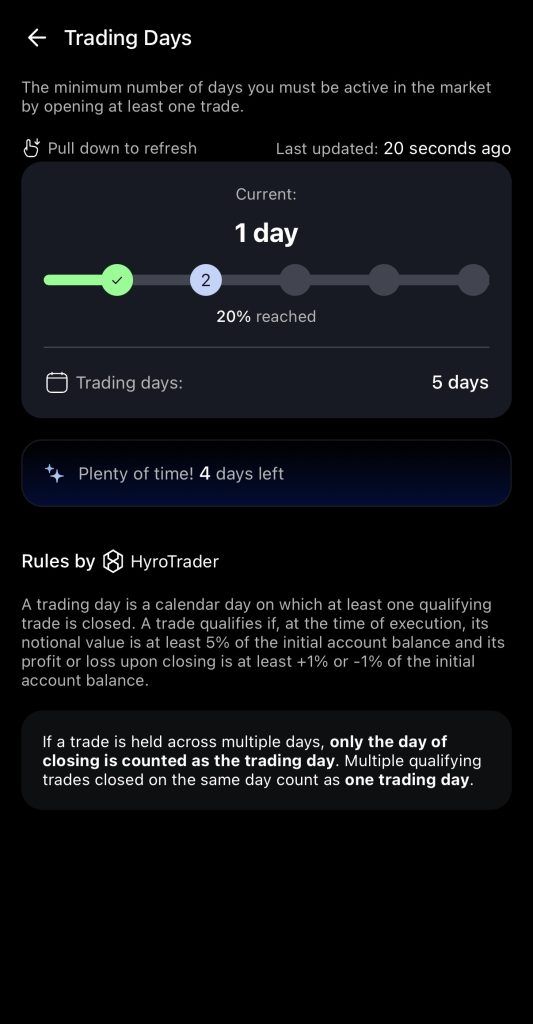
Minimum trading days with progress and details
You can tackle minimum trading days systematically by grading your setups: A+, B, etc. by how much you’re willing to risk on them so you know when to open such a sizeable trade. So, take those 5% trades only on A+ setups.
The biggest mistake with fulfilling minimum trading days comes at the moments of biggest success, when the trader has hit the profit target, but has to trade more to pass the challenge as they have a trading day left. It is very important that you don’t tilt in these circumstances but continue trading with the same risk approach as before reaching the profit target. The challenge is not passed until all criteria is fulfilled.
8) Trading Restrictions and Prohibited Strategies (Crypto Edition)
Crypto prop trading often includes restrictions even though crypto trades 24/7. However, most of these types of restrictions are more common among firms that also feature other assets besides crytpo. In crypto prop trading you’ll rarely find restrictions on holding over weekends for example.
However, restrictions often can include:
- restricted trading pairs (can’t trade low caps with more than a certain % of account size)
- leverage caps and position limits
- limits on number of open trades
- limits on copy trading and multi-account setups
Prohibited strategies often include:
- martingale
- grid strategies
- averaging down beyond risk limits
- latency exploitation and arbitrage
- strategies that exploit price feed delays or platform issues
These restrictions exist because firms want to remove “toxic flow” and system exploitation. Honestly if you show up to trade your strategy it’s unlikely you’ll break any of these rules in crypto. However, make sure you investigate what the firm says when buying a challenge, especially if you rely on low caps.
9) Hidden Prop Firm Rules Nobody Tells You About
Many violations are caused by “unwritten” realities rather than explicit rules. In trading many factors are unpredictable and when something does not go your way you end up breaking a rule. The extent to which these factors can influence your trading surprises many:
- Slippage breaks your risk model (!!!) Especially on low caps, this will be worse than you think.
- Spread widening happens at the worst moment
- Equity limits behave like liquidation guardrails
- Consistency rules plus profit targets create pressure traps
- Execution mistakes are treated as violations, even if your analysis was correct
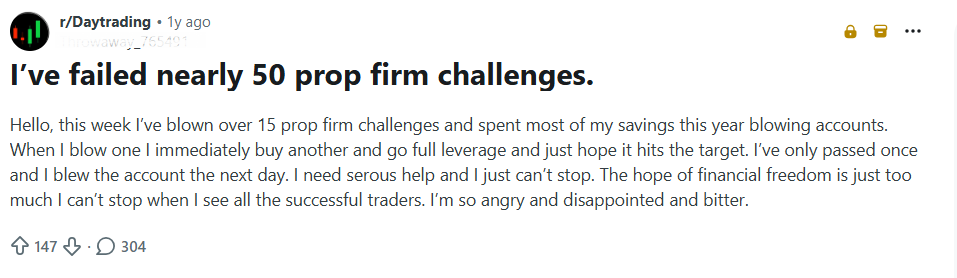
Some traders keep repeating their mistakes
One of the easiest and best things you can do to avoid failing a crypto prop challenge is to give a trial a shot with the prop firm and trading platform platform you’ll be using. In fact, it might be wise to consider this a must before you commit to a challenge. It’s rare for something not to be a surprise. There are simply too many moving parts in prop firm trading and you’re trying to get to trading in a state of boredom. Boring is repetitive and familiar. Trials can help with this.
10) Prop-Safe Risk Models That Reduce Violations
If you want to pass more consistently, use a model that reduces variance. You want your results to be repetitive. Make a plan in this respect because when you’re in the markets and you don’t have a plan you start to improvise. Improvisation leads to errors all trading, but it's more severely punished in prop trading.
Approach A: Fixed risk (one fits all) model (if no minimum trading days)
- risk 0.25% to 0.5% per trade
- stop after 1 to 2 losses
- max 3 trades per day
Approach B: Consistency scaling
- start at 0.25%
- scale to 0.5% only after 3 green days
- revert after any red day
Approach C: Drawdown buffer model
- treat firm limits as absolute
- trade with smaller internal limits as a barrier to breaches
- stop early and preserve buffer
These models are intentionally simple. Simple minimizes mistakes. Mistakes cause violations.
11) Why Execution Is a Hidden Edge in Crypto Prop Trading
Most traders focus on strategy. Ok most lose a challenge and then focus on strategy, but the reality is that execution is often an afterthought. While in legacy trading, traders go deep on platforms that provide speed and consistency, in crypto they are used to relying on tools that independent retail traders use. As you’re surely realizing crypto prop firm trading is a completely different beast.
In prop trading, execution is often the difference between passing and breaching.
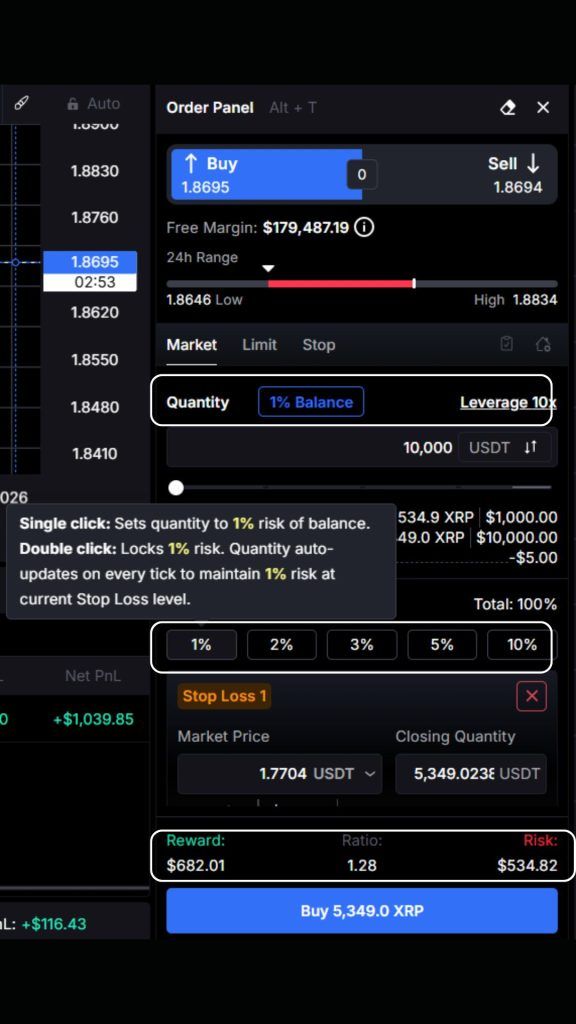
Customizable presets for position setting and automatic risk calculations can be a powerfull tool in crypto prop firm trading
Common breach causes are not strategy failures. They are workflow failures:
- wrong size by a decimal point
- delayed stop loss placement
- chasing entries with market orders
- trading from mobile without risk visibility
- failing to de-risk quickly when volatility changes
- no oversight on key challenge rules when you’re trading
That is why many serious prop traders build consistent live trading setups. Desktop execution for precision, mobile monitoring for fast risk checks, and a platform that makes order placement and risk control predictable.
It’s pretty unbelievable that most traders that are looking for funding are using a separate venue to execute orders and have no idea if they’re about to violate a key rule, especially on mobile.
This is also where CLEO fits naturally. CLEO is not a promise of passing a challenge. It is an execution layer that supports disciplined live trading. Traders use the desktop terminal for clean, precise and fast order placement and position management. The mobile app to stay on top of risk without being chained to a desk. In prop trading, that reduces unforced errors that lead to trigger rule breaches.
You have Qs we have the As: Crypto Prop Firm Rules
What are the most important crypto prop firm rules?
Daily drawdown, max loss (total drawdown), drawdown type (static or trailing), and consistency rules.
What is the daily drawdown rule in crypto prop firms?
The daily drawdown rule is a maximum loss limit per day. Many firms enforce it intraday using equity, meaning open positions count.
What is the difference between max loss and max drawdown?
Max loss usually refers to total allowed loss. Max drawdown can refer to static or trailing calculations. Always verify the baseline and whether equity or balance is used.
Why is trailing drawdown so difficult?
Because the drawdown floor rises as equity hits new highs. A market pullback can breach the limit even while you are in winning positions across the board. You may never even see a losing trade, and you may breach this rule.
Do crypto prop firms require stop losses?
Some explicitly do. Even when they do not, equity limits and consistency rules effectively require stop-loss discipline.
How do traders avoid breaking prop firm rules?
By keeping risk per trade low, stopping early on red days, trading fewer setups, avoiding high volatility, and using consistent execution workflows.
How to Win the Rule Game in Crypto Prop Firms
Crypto prop firm rules are not a checkbox. They are the constraint that defines which strategies work consistently in the long run.
If you want to pass and stay funded:
- understand equity vs balance enforcement
- respect daily drawdown like a hard stop with some buffer
- treat drawdown type as a strategy filter
- make stop-loss discipline automatic
- build consistency into your sizing and trade frequency
- grade your setups and attach risk to that grade
- do a trial with the prop firm before you commit to a paid challenge
- reduce execution errors, because violations are most often automated
If you treat the rules as part of your system, you will pass more often and stay funded longer. At the end of the day that’s exactly what you’re after.
If you're just jumping into crypto prop trading check out our full guide that outlines what exactly you need to master to pass that challenge.