
Crypto prop trading is becoming one of the fastest ways for capable traders to access capital without needing to have the funds themselves. Parabolic moves in crypto that can help traders build capital fast, are becoming scarce as the market is maturing. So, building your own account is more difficult.
If you can trade with discipline under rules (and there are some demanding prop firm rules out there), a prop firm evaluation can unlock a funded account, profit splits, and scaling plans that would otherwise take years to reach.
But there is a catch that most traders only understand after failing their first challenge. It goes against the way that many people that claim they’ve made a lot of money in crypto trade.
Prop firms do not fund “good traders.” They fund consistent rule followers. YOLOing into one position won’t get you anywhere. In fact, with most firms, you’ll fail the challenge.
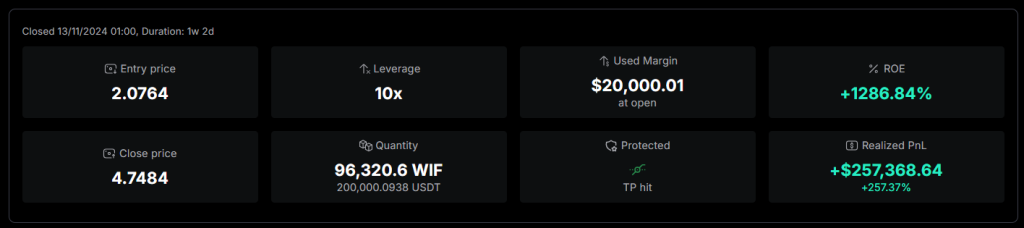
Imagine having a win like above and not passing the challenge?
In 2026, crypto prop firms are more competitive, more structured, and more risk-controlled than ever. Many traders are profitable in regular trading but fail prop challenges because their process cannot survive strict drawdown rules, daily loss limits, trading days requirements and consistency requirements.
Moreover, we’re seeing the rise of the crypto-only and crypto-first prop firms. There’s no lack of choice out there anymore.
This guide explains crypto prop trading end to end. You will learn:
- What crypto prop trading is and how it works
- The most common evaluation models in 2026
- The rules that matter most, especially drawdowns – pay attention to this one
- The strategies that fit prop constraints (and the ones that do not)
- Risk management frameworks designed to pass challenges
- Execution workflows that reduce mistakes and improve consistency
- A 14-day plan to pass your next challenge
You will also see how this connects to CLEO. It’s not that a great platform is the answer, professional execution capabilities across a desktop terminal and mobile app, instead of an exchange will help you avoid the mistakes that fail challenges.
Table of Contents
- What Is Crypto Prop Trading?
- Why Crypto Prop Trading Is Growing in 2026
- How Crypto Prop Firms Work: Models and Economics
- Understanding the Rules That Matter and Can Hurt Most
- Evaluation vs Funded Stage: What Changes (and What Should Not)
- The 2026 Crypto Prop Trading Meta
- The Best Crypto Prop Trading Strategies (Challenge-Proven)
- Risk Management That Passes Challenges (Not Just Protects Capital)
- Execution: The Hidden Edge in Crypto Prop Trading
- A 14-Day Action Plan to Pass a Crypto Prop Challenge
- Common Failure Patterns (and How to Fix Them)
- What To Evaluate Against
- Choosing a Crypto
- Prop Firm: A Practical Checklist
- FAQ: Crypto Prop Trading in 2026
- Conclusion: How to Get Funded and Stay Funded
1. What Is Crypto Prop Trading?
Crypto prop trading is a model where traders trade a firm’s capital after proving their ability through an evaluation. That evaluation you have to purchase.
Instead of depositing your own funds, you trade a bigger account under predefined rules that differ among firms. If you pass, the firm gives you access to a funded account and shares profits with you.

While the concept is similar to traditional proprietary trading, crypto prop trading is usually offered by specialized firms that run standardized programs: challenge-based evaluations, clear risk limits, and predictable scaling plans. In many cases the process is automated to avoid any foul play.
The Core Idea
- You buy a challenge or sometimes monthly subscription.
- You trade a simulated environment (or rarely in crypto prop trading real market environment depending on the firm’s setup).
- You follow strict rules that differ slightly among firms and challenges.
- If you hit the profit target and respect risk limits, you pass.
- You get a funded account (you get to call yourself a funded trader!) and earn a profit split.
Why Traders Choose Crypto Prop Trading
Crypto prop trading appeals to traders because it offers:
- Faster access to large capital – you can go from idea to deep funds fast
- Lower personal capital risk (you are not trading your full bankroll)
- Clear progression and scaling plans
- The ability to monetize skills even with limited savings
- Trading large amounts gives traders a sense of leeway
The Tradeoff
The tradeoff is that you trade under rules that often remove or penalize your usual flexibility. You can be very profitable and still fail.
Most prop challenges are not designed to identify the highest return traders. They are designed to identify traders who can:
- Control losses
- Avoid catastrophic days
- Follow a plan consistently
- Have consistent wins over time
- Keep delivering in different market conditions
- Maintain stable behavior under pressure
2. Why Crypto Prop Trading Is Growing in 2026
Crypto prop trading has grown rapidly because the market has matured, and traders are looking for structured ways to trade professionally without having the finds themselves upfront.
Several trends in 2026 continue to drive adoption:
2.1 Higher Market Liquidity and More Tradable Assets
Liquidity in BTC and ETH remains deep, and more derivatives products allow traders to control positions with defined risk. Many prop firms focus on these high-liquidity pairs because they reduce slippage risk and improve execution quality. However, crypto moves fast and plenty of these firms allow you to trade the flavor of the day.
2.2 Lower Barriers to Entry
Independent retail traders can access evaluation programs for relatively small fees compared to the capital they can trade once funded. They can trade from most countries. For skilled traders, this makes the risk-reward very attractive.
2.3 Demand for Risk-Controlled Trading
After several boom-bust cycles, the market has shifted. Traders increasingly value:
- capital efficiency and maintenance
- risk control
- robust, repeatable methods
Prop firms fit that demand by enforcing discipline.
2.4 The “Second Career” Opportunity
Crypto prop trading has become a path for:
- part-time traders who want structure and a goal
- experienced traders who want scale
- former professionals who want remote flexibility
- and let’s face it traders without enough experience that want to give it a shot
3. How Crypto Prop Firms Work: Models and Economics
Crypto prop firms vary in details, but most follow a few core models. Your success depends on choosing a model that fits your trading style and then adapting your strategy to the firm’s rules.
3.1 Common Crypto Prop Trading Models in 2026
Model A: One-Step Evaluation
You trade one phase. You hit a profit target while respecting drawdown rules and trading day requirements.
Typical characteristics:
- Profit target: 8% to 12%
- Time limit: often none, sometimes 30 to 90 days
- Max Drawdown: around 6%
- Daily Drawdown: 3% to 5%
- Min trading days: 3 to 10
Who it suits:
Disciplined traders with consistent systems.
Risk:
Traders often take excessive risk to pass fast, or in volatile crypto big hits don’t turn into challenge success.
Model B: Two-Step Evaluation (Most Common)
Phase 1 requires a larger profit target. Phase 2 requires a smaller target, often with similar risk rules.
Typical characteristics:
- Phase 1 target: 8% to 10%
- Phase 2 target: 4% to 6%
- Max Drawdown: 8% to 10%
- Daily Drawdown: around 5%
- Min trading days: 5 to 10 per phase
Who it suits:
Traders who can stay consistent across time, and who want a more credible funding process.
Model C: Instant Funding
You skip evaluation or complete a minimal assessment and get funded immediately, usually with stricter rules and lower starting drawdown.
Typical characteristics:
- Lower max drawdown
- Lower profit split at first
- Higher upfront fee
- Stronger consistency monitoring (this is very important to note, many traders underestimate the impact)
Who it suits:
Experienced traders who already have controlled risk frameworks and do not need challenge mode structure.
3.2 Profit Splits and Payouts
Most firms offer profit splits between 70% and 90%. Some offer scaling plans that increase profit split or capital allocation.
Typical payout schedule in 2026:
- Daily/On demand (this is becoming much, much more frequent), twice a week or monthly payouts
- Minimum profit thresholds
- Verification and compliance steps
3.3 Scaling Plans
Scaling is one of the main reasons to choose prop trading. It offers a structured path to manage more capital based on performance.
Scaling usually depends on:
- hitting profit milestones
- staying within drawdowns
- maintaining consistency
- usually trading volume or number of active days
Example scaling structure (example)
Stage | Account Size | Requirement | Profit Split
Funded Start | $25,000 | Pass evaluation | 80%
Scale 1 | $50,000 | +10% profit, no rule breaches | 80%
Scale 2 | $100,000 | +20% cumulative profit | 85%
Scale 3 | $200,000 | +30% cumulative profit | 90%
This is why consistency matters. A trader who avoids failures may earn more than a trader with higher short-term returns but repeated rule breaches.
4. Understanding the Crypto Prop Trading Rules That Matter Most
If you want to succeed in crypto prop trading, you must treat rules as part of the strategy. This is not something you can compromise with.
It may sound obvious, but you can see confused crypto prop firm trading newcomers getting hurt all the time. A strategy that makes money but breaks rules is not a strategy for prop trading. If this level of structure is not for your trading style, reconsider engaging with crypto prop firms for now. You’ll save yourself a lot of frustration.
This section covers the key rules that matter most in 2026, with practical examples.
4.1 Drawdown Rules (The Most Important)
Drawdown rules define the minimum account equity you must maintain, or it’s the amount you can lose. Violating drawdown rules usually fails the evaluation or closes the funded account.
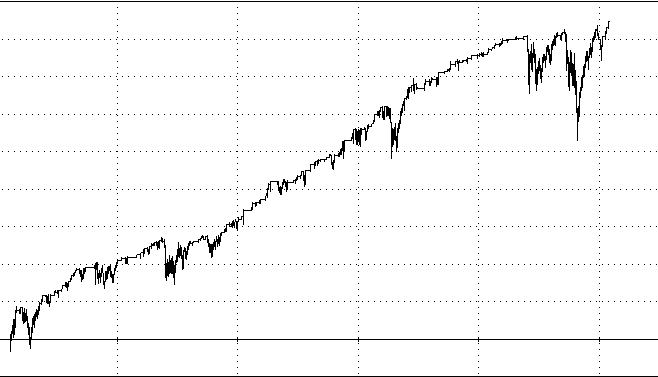
The drawdown above would likely have you fail the challenge despite being profitable. Source: Quantified Strategies
There are two major types: static drawdown and trailing drawdown.
Static Drawdown (Fixed)
A static drawdown is calculated from the starting balance. It does not move as your equity increases.
Example:
- Starting balance: $10,000
- Max drawdown: 10%
- Minimum equity: $9,000
As long as you stay above $9,000, you remain compliant.
Why traders prefer it:
It is predictable and easier to manage with consistent risk.
Trailing Drawdown (Moving)
Trailing drawdown follows your equity as it increases. The drawdown floor rises when your account hits new highs.
Example:
- Starting balance: $10,000
- Trailing drawdown: 10%
- You grow to $11,000
- The new floor becomes $9,900 (depending on firm rules)
Trailing drawdown creates a common trap: traders take profits early, then the trailing floor rises, and a single pullback triggers failure. It feels like becoming a victim of your own success.
Why trailing drawdown is difficult:
It punishes volatility and encourages smooth equity curves. This for many crypto traders is very difficult to manage. If you have no data if tour strategy can withstand this, it’s best to gather it before considering crypto prop firm trading.
Table: Static vs Trailing Drawdown
Feature | Static Drawdown | Trailing Drawdown
Drawdown floor moves up? | No | Yes
Easier to manage? | Yes | No
Best for | Swing, trend, consistent setups | Low volatility strategies
Biggest danger | Large early loss | Giving back profits, volatility
Common failure pattern | Over-leverage/massive position size early | Passing then failing near target
4.2 Daily Loss Limits/Daily Drawdown
Daily loss limits cap how much you can lose in a single day. This rule exists because prop firms want traders who cannot blow up quickly.
Daily drawdown limits are probably the biggest challenge for traders because traders:
- widen stops
- revenge trade
- increase size after loss
- trade too frequently
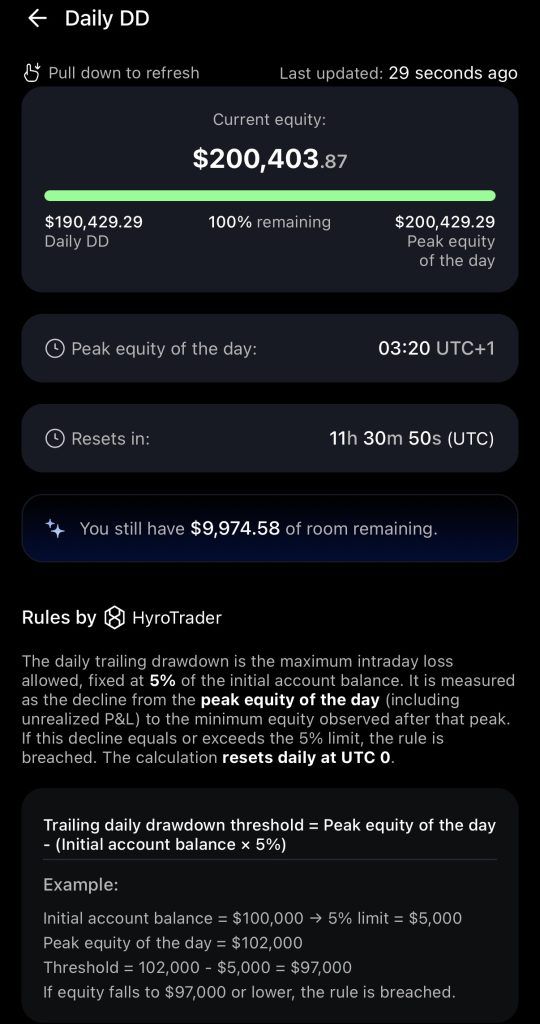
Idealy you'll have a detailed overview on your progress in regards to every single criteria of the prop challenge
Daily loss limits are best treated as a hard stop, not a guideline. The best idea is to have a more cautious personal rule, that would prevent you from even going near to those enforced by the prop firm.
Table: Recommended Daily Loss Limit Policy (Personal)
Your Firm’s Daily Limit | Suggested Personal Stop | Reason
5% | 2% to 2.5% | Buffer against slippage and mistakes
4% | 1.5% to 2% | Avoid “one bad day” failures
3% | 1% to 1.5% | Forces fewer trades and better setups
Here's a simple explanation of daily drawdown.
4.3 Minimum Trading Days
Many evaluations require a minimum number of trading days. This prevents traders from passing in one lucky session and be frustrating in the beginning.
If a firm requires 10 days, you must plan to trade a consistent daily approach. Trying to force trades just to “count days” is one of the most common mistakes.
A better approach:
- trade only when your setup appears
- if no setup, do not trade
- accept that passing will take longer – this should be your alpha and omega
- build a schedule around your best market sessions
4.4 Consistency Rules and Profit Caps
Some firms include restrictions like:
- maximum profit per day
- maximum percentage of profit to fulfill the profit target from one trade
- limits on trading during high volatility events
These rules exist to discourage gambling behavior. If your strategy relies on occasional large wins, it may not be compatible. It’s important to deeply investigate your system, as you are probably becoming aware.
4.5 Restricted Assets, Times, or Leverage
Some firms restrict:
- trading certain altcoins or limitations on groups of them
- holding positions over weekends (more of a legacy practice)
- maximum leverage
- trading during major news events
- stop loss size as a percentage of account maximum size
Before you start an evaluation, read the prop firm’s rules carefully and confirm your strategy fits. Better yet do a trial, but we’ll get to that.
5. Evaluation vs Funded Stage: What Changes (and What Should Not)
Many traders treat evaluations as a separate “mode.” They trade aggressively to pass, then try to become disciplined only once funded. That often leads to quick failure. And then a few more.
The best approach is to trade the evaluation exactly as you plan to trade funded.
5.1 What Changes After You Get Funded
- Payout schedules matter
- Consistency monitoring is often stricter
- Your psychological pressure increases with real payout potential (don’t underestimate this)
- Some firms reduce the profit target requirement or remove it entirely
- Scaling rules become relevant
5.2 What Should Not Change
- Risk per trade
- Max daily drawdown personal policy
- Your setup selection criteria
- Your execution process
- Your trading hours and market focus
If you need to change your style to survive funded rules, it means you passed the evaluation in a way that is not sustainable.
6. The 2026 Crypto Prop Trading Meta
“Meta” means what tends to work best given the current market structure and the environment created by prop firm rules.
In 2026, the meta is shaped by:
- strict max drawdowns and even stricter daily drawdowns
- heavy monitoring of behavior
- mature market liquidity in majors
- increased volatility around macro and regulatory events
- the need to follow liquidity/trends
The strategies that perform best are those that:
- prioritize predictable risk
- trade liquid instruments (slippage is not your friend)
- avoid frequent re-entry and noise
- reduce equity volatility
- maintain controlled exposure
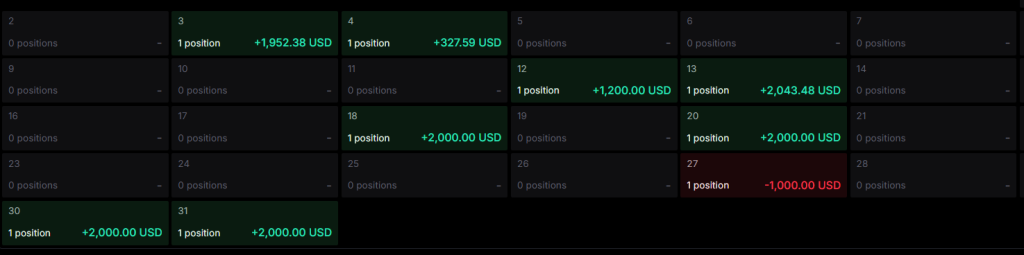
The consistent trading results that work
6.1 What Typically Works Well in 2026
- Trend continuation on BTC and ETH
- Breakout continuation only on defined, high-quality levels
- Range mean reversion in sideways markets
- Low-frequency, high-conviction setups
- Monitoring the rotation of liquid assets
6.2 What Typically Fails in 2026
- High-leverage scalping with very tight stops (slippage will ruin your returns and haywire your risk)
- Trading illiquid altcoins (spreads and spikes)
- Overtrading and frequent position flips
- Trading purely to “hit the target quickly”
- Unplanned discretionary trading with inconsistent stop placement (you should avoid this in most trading occasions really)
This is important: prop firm rules make your strategy a risk system. If your strategy produces an erratic equity curve, the rules will fail you even if the strategy is profitable long-term. You’ll need to investigate your performance like never before if you’re going down the prop firm path.
7. The Best Crypto Prop Trading Strategies (Challenge-Proven)
Find a deep dive on creating your first trading strategy as a begginer here.
The best prop strategies are not necessarily the most profitable in normal accounts. They are the strategies that fit the constraints: limited drawdown, daily loss limits, and consistency rules.
Imagine if you were managing someone else’s money and have to give updates. Sharing deep drawdowns, and steep ups and downs would not be the most confidence boosting information to continuously receive.
Below are strategies that align well with prop trading in 2026.
You’ll notice general principles are discussed instead of detailed methods. For detailed strategies with entry criteria, stop losses and targets check out our Twitter and TradingView. You can also find regular updates on popular strategies like Judas Swing.
Strategy 1: Trend Continuation (Best Overall)
Trend continuation is one of the best “basic strategies” for prop challenges because it naturally encourages fewer trades, cleaner invalidation points, and higher win-rate stability.
Best pairs: BTC, ETH and trending assets
Timeframes: 15m to 4H
Market condition: trending, directional phases
Setup example:
- Identify trend direction on 4H or 1H
- Mark key pullback zones (previous support, VWAP, moving average zone, structure level)
- Wait for pullback
- Enter on confirmation (reclaim of level, bullish/bearish structure shift, or volume confirmation)
- Stop beyond structure
- Target 2R to 3R or partials along the way (if you’re not used to partials, you might need to look into it)
Why it works for prop:
- fewer trades reduces rule breach risk
- strong risk-reward potential
- avoids noisy intraday churn
Why it might be problematic:
- might not boost trading days and if undisciplined, you might try to compensate eventually
Strategy 2: Range Reversion (Best in Sideways Markets)
Crypto spends significant time ranging, even more so lately it seems. Range reversion strategies are excellent for passing challenges because they can produce smooth equity curves with controlled risk.
Best pairs: BTC, ETH, major liquid pairs
Timeframes: 5m to 1H
Market condition: defined ranges, low trend strength
Setup example:
- Define range high, range low, and midline
- Look for failure patterns at edges (rejection wick, volume exhaustion)
- Enter near the edge with stop just outside the range
- Take partial profit at midline
- Exit remainder near opposite edge or at midline depending on volatility
Why it works for prop:
- frequent but controlled opportunities
- stop placement is clear
- equity curves tend to be smoother
Why it might be problematic:
- sometimes waiting on the range to solidify will lead to missed opportunities
Strategy 3: Breakout Continuation (More Advanced)
Breakout strategies can pass prop challenges, but they must be structured. Random chasing is one of the fastest ways to hit daily limits.
Best pairs: BTC, ETH
Timeframes: 15m to 1H
Market condition: compression, catalysts, high-volume expansion
Setup example:
- Identify consolidation range near a key level
- Confirm accumulation or decreasing volatility
- Place limit entry on breakout retest, don’t chase
- Stop inside the range
- Target 2R to 3R or even better dynamically based on ATR expansion
Why it works for prop:
- large moves can accelerate targets without gambling
- structured entries reduce slippage risk
Why it might be problematic:
- Breakouts often occur during volatility. Execution quality matters a lot and slippage can destroy your planned risk.
- You will need to monitor markets a lot
Strategy 4: Structured Discretionary (Only If You Have a Playbook)
Some traders pass with discretionary approaches, but only when structured into repeatable playbooks. In truth this requires experience.
A discretionary system must include:
- defined setup types (2 to 4 max)
- risk rules for each setup
- strict stop placement logic
- no “maybe trades”
- post-trade review and journaling
If your discretionary approach is truly systematic, it can pass prop challenges. If it is emotional, it will likely fail.
Table: Strategy Fit for Prop Trading
Strategy Type | Pass Potential | Difficulty | Best Use Case
Trend continuation | Very high | Medium | BTC/ETH directional moves
Range reversion | High | Medium | Sideways markets, stable sessions
Breakout continuation | Medium to high | High | Catalysts, compression, high liquidity
High-leverage scalping | Low | Very high | Rarely compatible with rules
Altcoin momentum | Low | High | Spreads and volatility risk
8. Risk Management That Passes Challenges (Not Just Makes Money)
Risk management is not a supporting skill in crypto prop trading. It is the primary skill, and this is something you need to fully embrace.
Most traders fail because they risk too much early, then panic when they approach drawdown limits, leading to even more mistakes. The goal in a prop evaluation is not maximum return. It is maximum probability of survival while moving steadily toward the profit target.
Deep dive into position sizing here.
8.1 The Prop Passing Risk Framework
A reliable risk framework for prop challenges includes:
- Risk per trade: recommended 0.25% to 1% - what really matters is the stop loss level
- Daily max loss: 1% to 2% (even if firm allows more)
- Max trades per day: 1 to 3
- Only A+ setups
- Reduce risk after losses
- Increase risk only after consistent green days
- Avoid trading during fatigue, stress, or uncertain conditions. Please do.
Table: Recommended Risk Settings by Account Type
Account Size | Risk per Trade (SL) | Daily Stop | Weekly Stop | Target Daily Gain
$10,000 | 0.25% to 0.5% | 1% | 3% | 0.3% to 0.8%
$25,000 | 0.25% to 0.5% | 1% to 1.5% | 3% to 4% | 0.3% to 1%
$50,000+ | 0.25% | 1% | 3% | 0.2% to 0.7%
Why daily gain targets might seem small if you’re coming from classic crypto retail: because prop challenges reward survival. The profit target can be reached with steady compounding and consistent execution. Longer term thinking is a must.
8.2 R-Based Risk: The Best Way to Stay Consistent
Using R (risk units) helps you stay consistent regardless of volatility. Think of it like how many turns you can have in a video game before you have to step away.
Example:
- 1R = $50 risk
- Every trade has a defined Stop Loss so the risk is always $50
- You stop trading after losing 2R
This prevents you from “adjusting” risk emotionally and negotiating unsound increases with yourself.
8.3 Avoiding the Biggest Risk Trap: Profit Target Pressure
Profit targets create pressure. Many traders feel they must pass quickly, when in reality the prop firm has 0 such rules. It’s interesting how one of the toughest aspects of crypto prop firm trading is not imposed by anyone but traders themselves.
This often leads to:
- increasing leverage or position size
- taking lower-quality setups
- trading during bad market conditions or boredom
- ignoring the daily stop
You should treat the evaluation as a funded test of discipline. Passing fast does not matter if you cannot keep the funded account. It really does not matter, don’t defeat yourself this way.
8.4 Consistency Over Aggression
A consistent, low-volatility equity curve is a competitive advantage in prop trading. Now in crypto trading, this is not a very common occurrence. Plus, the difference can be subtle.
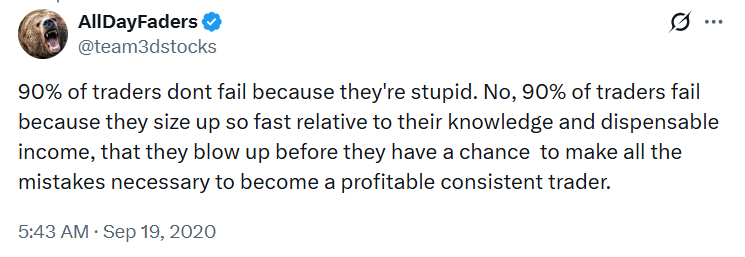
A trader with a 55% win rate and 1.8R average win can pass and stay funded if they avoid large drawdowns and follow rules.
A trader with a 45% win rate but frequent 5R wins may pass occasionally but will often fail due to volatility and drawdown breaches.
9. Execution: The Hidden Edge in Crypto Prop Trading
Most content about crypto prop trading focuses on strategies and rules. That is incomplete.
In prop trading, execution is a major edge because:
- drawdown rules are easier to break with slippage and errors
- daily limits punish mis-clicks and imperfect, unplanned exits
- tight risk plans require precise and consistent stop placement
- traders must manage positions under pressure
Even strong strategies fail when execution is inconsistent.
9.1 What “Professional Execution” Looks Like
There’s a lot of talk about doing things without emotions and generally any conversation about professionalism lacks steps to follow as those who talk about it wrap it mystique like it’s unachievable. That’s a lie.
Here are the 10 rules of professional execution in crypto prop trading:
- You know your risk before you enter
- You know your exit/s before you enter
- You place stops immediately
- You focus on a limited number of pairs that you can realistically monitor
- You avoid market chasing when possible
- You know exactly why you’re entering that position if asked
- You can manage positions quickly on desktop
- You can monitor risk and exposure on mobile
- You can de-risk during volatility without panic
- You know exactly where the sum of your positions is in relation to the prop firm rules
9.2 Why Execution Matters More in Prop Trading Than Normal Trading
In normal trading, you can survive mistakes by lowering size, adding capital, withstanding a drawdown or taking a break. In prop trading, a single mistake can fail your evaluation.
Examples:
- An unplanned market order increases slippage, which increases loss size, which pushes you into daily limit.
- A delayed stop placement during a rapid candle causes you to forget about the stop loss or stop loss as a % of account rule.
- A missed exit while away from the desk triggers drawdown breach.
These are not strategy failures. They are workflow failures.
9.3 The Desktop + Mobile Workflow Advantage
A serious prop trader needs two environments:
- Desktop terminal for analysis, planning, entries, and advanced order management
- Mobile app for monitoring and rapid risk management when away from the desk
The difference between passing and failing is often the ability to reduce risk quickly when conditions change. Crypto is just as susceptible to news as any other market, with even stronger, more exaggerated reactions. Plus, it’s always open so whatever happens gets an immediate consequence in the markets.
This is where platforms matter. A modern execution layer like CLEO’s desktop terminal and mobile app can support disciplined trading workflows, such as:
- the most elegant position and challenge progress monitoring in trading
- easier stop-loss and take-profit management
- clear on risk-to-reward before you even place the position
- consistent interface across devices
- quick de-risking from mobile
- precise position adjustments
- controlled order execution without improvisation
- customizable presets give you unprecedented control over risk
- sophisticated risk management with multiple stop losses and take profits
- visual trading for tackling assets with decimals
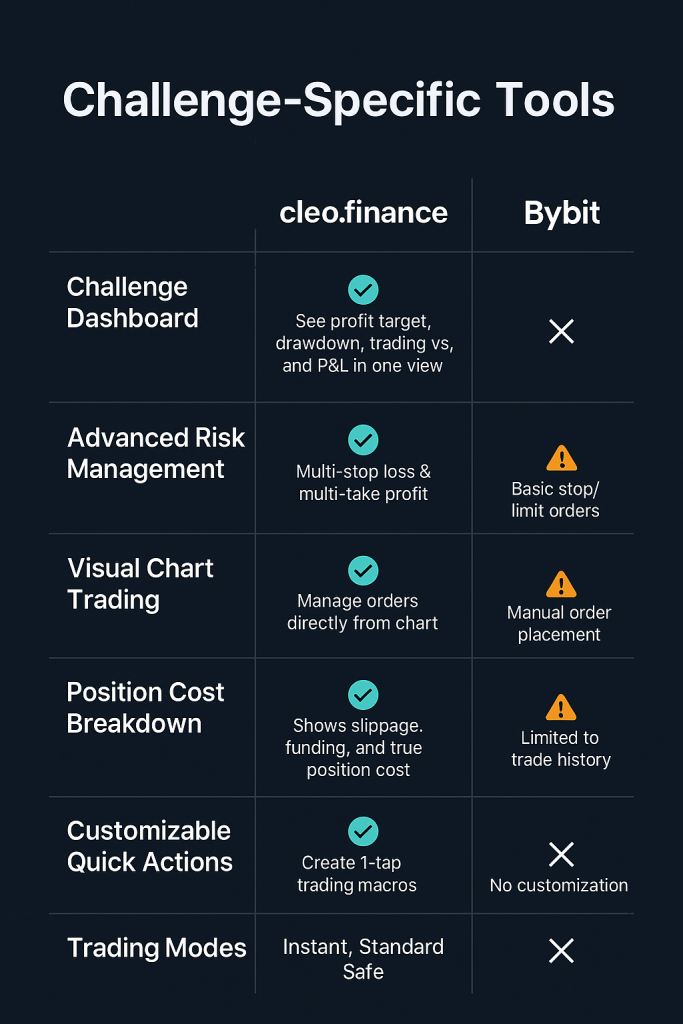
Whatever you choose to execute on is fine as long as you know the tradeoffs
The value is not “more trades.” The value is fewer mistakes, faster execution and precision through confidence. Exchanges are great, but they’re not trading tools built to follow strict plans.
9.4 A Simple Execution Checklist for Prop Trading
Before every trade:
- Is this an A+ setup from your plan? (Break this down, it will help a ton)
- Where is the invalidation point?
- What is the stop distance?
- What is the risk-to-reward?
- Do you have a clear exit plan?
During the trade:
- Stop is placed immediately
- If the trade is invalidated, you exit without adjusting
- If volatility spikes, you reduce exposure before it becomes emotional
After the trade:
- Log it
- Mark whether you followed the plan
- Identify execution errors if any (not just strategy errors)
10. A 14-Day Action Plan to Pass a Crypto Prop Challenge
Most traders fail because they do not have a structured plan. They “start trading” and hope to reach the profit target. This results in wasted time and money. It seems it’s a right of passage for every trader but do yourself a favor and skip the not-having-a-plan phase. Your future self will thank you.
A plan reduces pressure and improves decision-making.
Below is a realistic 14-day plan for a typical evaluation with a 8% to 10% target and minimum trading days requirement.
Days 1 to 3: Establish Rhythm and Consistency
- Trade only one setup type
- Risk 0.25% per trade
- Max 2 trades per day
- Stop for the day after 1 loss
- Focus on clean execution
Goal: start with controlled behavior, not profit. Focus on the process as that is something you can improve.
Days 4 to 7: Controlled Scaling
If you have at least 3 green days and no rule breaches:
- increase risk to 0.5% per trade
- keep max trades at 2 to 3
Goal: steady progress toward target.
Days 8 to 10: Protect Gains
- reduce risk slightly if you are up
- avoid high volatility sessions unless your setup requires it
- prioritize protecting equity curve
Goal: avoid giving back profits and protect drawdown buffer.
Days 11 to 14: Finish Strategically
If you are within 1% to 2% of the target (this is truly a moment that causes many traders to tilt):
- reduce risk again (0.25%)
- do not trade marginal setups
- avoid “just one more trade” thinking
Goal: complete the evaluation without unnecessary risk.
11. Common Failure Patterns in Crypto Prop Trading (and How to Fix Them)
Understanding why traders fail helps you avoid predictable traps.
Failure Pattern 1: Over-leveraging Early
Many traders try to pass quickly by taking large risk early. This leads to early drawdown hits and emotional trading, plus unfixable confidence issues.
Fix:
- risk 0.25% to 0.5%
- accept slower progression
- focus on survival and building confidence
Failure Pattern 2: Revenge Trading After a Loss
A loss triggers a need to “recover” quickly. This often causes overtrading and daily limit breaches.
Fix:
- daily stop rule: stop after 1 to 2 losses, just walk away
- review the loss, do not trade immediately
- build a habit of stopping
Failure Pattern 3: Trading Low-Quality Setups
Prop rules punish random trades as you will notice very quickly once you start a challenge. Low-quality setups increase variance and drawdown.
Fix:
- trade fewer setups
- define your A+ criteria (please ASAP)
- accept that some days you do not trade
Failure Pattern 4: Execution Errors Under Pressure
Mistakes like wrong size, late stop placement, or chasing entries ruin a good strategy.
Fix:
- pre-trade checklist
- use presents and visual execution where possible
- use a platform and workflow that reduces friction
- keep mobile monitoring available to avoid missed management
12. What to evaluate your prop trading results against?
If you are not clear on what you are looking for when reviewing a loss or what execution would you consider correct you may be lacking a strategy built by data and backtesting. You’ve probably heard this before but unless you have the data to know if your strategy is behaving as expected your emotions will take over.
You can also refine your approach by forward testing, the key thing is to have the data that will help you stay on track.
Key Questions to be Able to Answer in Evaluations
Did I respect the entry/exit checklist?
Do the winning/loosing streaks match what I expected?
Do the positions take as long as was expected?
Are the key metrics (win-rate, Profit Factor, etc) of my strategy hitting reasonable numbers?
Am I sticking to the pairs I’ve mastered?
If I overtraded, which setups should I have avoided?
With some backtesting experience this should come easy. If not this is the first thing you should start with.
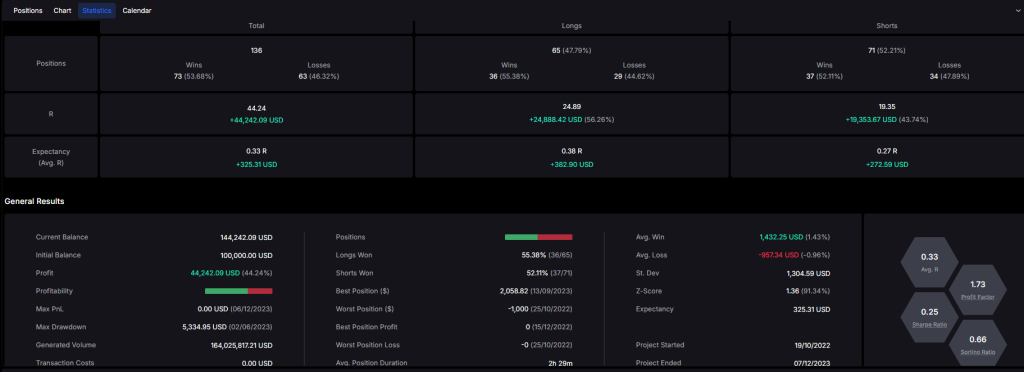
Detailed backtesting statistics
Check out the CLEO Backtesting Guide for an introduction.
13. Choosing a Crypto Prop Firm: A Practical Checklist
You do not need the “best” firm. You need the firm whose rules match your strategy and behavior. There are subtle differences that will boost or compromise your experience.
Rules are discussed above, but one thing that only some prop firms have is real exchange liquidity and position cost transparency. If you run into a firm that does not clarify on what data exactly, you’re trading don’t engage. You’re looking for liquidity that matches something in the real world, like what you’d get on Binance. Otherwise, the data may not be true or may be open to manipulation.
Another thing that traders often miss is the cost of their positions. We’re talking about more than just fees here. Ideally you want to know the commissions, funding and slippage on every position you close.
Firm Selection Checklist
Category | What to Look For | Why It Matters
Drawdown type | Static or recalculated at a specific time preferred | Easier risk planning
Daily loss limit | Reasonable buffer | Protects from one bad day
Time limit | Flexible or none | Reduces pressure
Consistency rules | Clear, not overly restrictive | Avoid surprises
Trade environment | Clear information on execution and slippage | Strategy reliability
Liquidity | Real exchange liquidity | Real-world performance
Payout policy | Transparent schedule and requirements | Avoid disappointment
Transparency | Full breakdown of position cost: commissions, funding and slippage | Better performance
Customer support | Fast and responsive | Rule clarity and trust
Instruments | BTC, ETH, majors supported, onboarding new projects | Liquidity and execution
Red Flags
- unclear rules about trailing drawdown
- confusing payout requirements
- vague restrictions that can be interpreted arbitrarily
- heavy marketing with little documentation
- unrealistic profit promises
- adding rules that did not exist when you started the challenge
- no insight on position costs
14. FAQ: Crypto Prop Trading in 2026
What is crypto prop trading?
Crypto prop trading is a model where traders trade a firm’s capital after passing an evaluation. Traders earn a percentage of profits while following strict risk rules.
Is crypto prop trading worth it in 2026?
It can be worth it if you are already disciplined and consistent. It is not ideal for traders who rely on aggressive leverage or inconsistent behavior. You must investigate your strategy to see if this level of structure is for you. It’s ok if not – some traders thrive following their own plan.
Can beginners pass crypto prop trading challenges?
Beginners can pass if they read the rules, do a trial, use simple strategies, low risk per trade, and strict daily stop rules. Most beginners fail due to overtrading and emotional decision-making.
What is the most important rule in prop trading?
Drawdown rules, both overall and daily, are the most important. Understanding how your drawdown is calculated determines whether your strategy is compatible. This does vary by prop firm and challenge within the same firm. Do not skip confirming.
What is the best strategy for passing a crypto prop challenge?
Trend continuation and range reversion strategies on BTC and ETH are commonly effective because they offer clear invalidation and controlled risk. However, what you’ve verified that fits the prop firm rules, and you can trade with discipline is always the best answer.
How much should I risk per trade in a prop challenge?
Most traders succeed by risking 0.25% to 0.5% per trade. Higher risk increases volatility and drawdown failure probability. Don’t get overly hung up on position size, what really matters is your stop loss level.
Why do traders fail even when their strategy is profitable?
Because prop rules punish volatility, slippage, and emotional decision-making. Many profitable strategies fail under tight drawdown and daily loss constraints. Not to mention consistency rules that disallow massive wins from making the majority of your profit target. Often traders have no idea if their strategy fits the prop trading criteria due to lack of backtesting and data.
How do I stay funded after passing?
Use the same risk plan that passed the evaluation, avoid increasing leverage, follow daily stop rules, and focus on consistent execution workflows. Don’t fix what’s not broken.
15. Finally: How to Get Funded and Stay Funded
Crypto prop trading in 2026 offers a clear path to trading meaningful capital, but it rewards discipline more than inconsistent great success. This can be frustrating at times if it does not fit your trading style. Remember: you can be an awesome trader, but still never pass a prop firm challenge.
To pass and stay funded:
- Choose a firm whose rules match your strategy - there is no “best crypto prop trading firm”
- Do a trial to eliminate any surprises
- Treat prop rules as part of your trading system
- Use strategies that create stable equity curves
- Keep risk per trade small
- Use strict daily stops on every single position
- Build a professional execution workflow across desktop and mobile
The traders who succeed are not necessarily those with the highest returns. They are the traders who can perform consistently under constraints. As crypto fluctuates and goes through cycles this requires mastery, or at least the ability to adapt.
If you want to increase your probability of success, don’t only improve your strategy. Improve the system that executes it. That means risk structure, behavior, and an excellent grasp of a platform that offers more than exchanges,
A consistent execution environment, across a desktop terminal and mobile app, can be a meaningful edge because it reduces mistakes, keeps risk controlled, and helps traders act like professionals.
Prop trading can be risky, check out the regulatory body in your country (Europe, US or elsewhere to make sure you’re informed.