
Daily drawdown is probably the rule that has hurt the most traders looking for funding. It catches more traders off guard than any other rule. Not enough profits is not the issue that new traders fail on – daily drawdown (sometimes called max loss) is. Here is everything you need to know, explained simply, so daily drawdown is never the reason you breach your account.
If you’re just starting out with crypto prop trading and need a full guide we have that covered too.
The Simple Version of Daily Drawdown in Crypto Prop Trading
A daily drawdown rule puts a limit on how much you can lose in a single day.
Go under that limit, even for a moment, and your challenge is over. Instantly. No warning, no second chance.
That’s it. Everything else is just the details of how that limit is calculated.
The Part Most Traders Miss: It Is Based on Equity, Not Balance
This is where most traders get caught out.
Your balance is what your account is worth with all trades closed. Your equity is what your account is worth right now, including any open positions that are currently winning or losing.
Daily drawdown is enforced on your equity. That means if you have an open trade that is moving against you, those losses count immediately, even if you have not closed the trade yet.
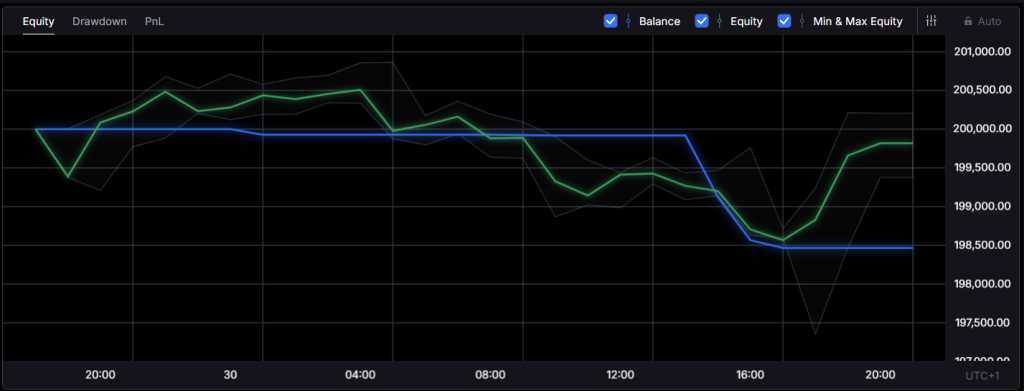
You can have a positive closed balance and still breach your daily drawdown because of a single open position running against you.
Example:
- Your account balance is $10,200 from a winning trade earlier
- You open a new position that moves against you
- Your equity drops to $9,490 including that floating loss on the open position
- Your daily drawdown limit was $500 from a $10,000 starting point
- Challenge failed, even though your closed balance is still in profit
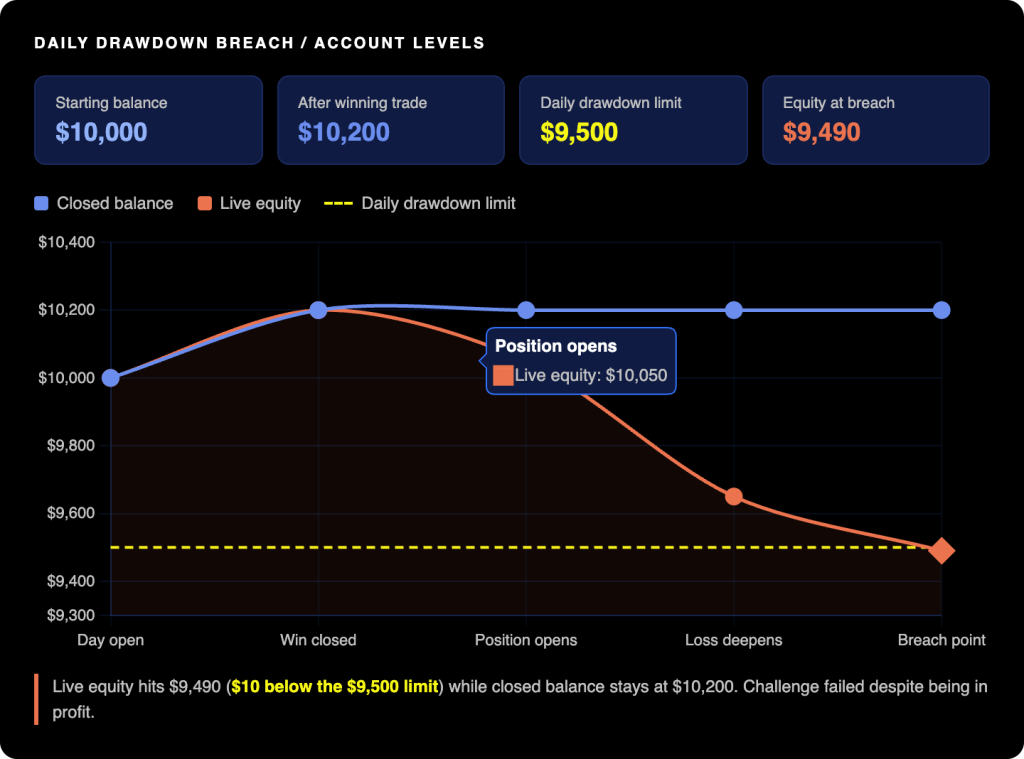
This surprises a lot of traders the first time it happens. Before you enter prop trading you don’t treat open trades with such gravity, although most traders would benefit from it. Crypto trading is known for volatility so a red day where you’re 10% under water is nothing. In prop trading it would cost you your challenge.
Why Does Max Loss Exist?
Prop firms are giving you access to their capital. In exchange, they need to know you will not blow up the account in a single bad day. The daily drawdown rule is their protection against that. It forces you to manage risk on a day-by-day basis, not just overall.
Without it they would be giving funding to traders that may have positions under water for a long time. Long periods of drawdown are not something that people look to invest in.
Think of it like a circuit breaker. Once it trips, everything stops and this is what the majority of crypto prop firms use to gauge consistent drawdown risk.
How the Dollar Limit Is Calculated for Your Challenge
The daily drawdown amount (sometimes called daily loss) is always a percentage of your initial account balance the size of the account you bought when you started the challenge.
It’s important to understand that it does not grow as your account grows. If your daily drawdown is 5% on a $10,000 account, your daily limit is always $500, whether your balance has grown to $11,000 or $12,000.
This means the more profitable you become, the tighter your daily drawdown is as a percentage of your actual current balance. It is something most traders never think about until they are well into a challenge.
A Simple Daily Drawdown Example
- Account size: $10,000
- Daily drawdown limit: 5%
- Fixed dollar allowance: $500
- Breach level: $9,500
If your equity drops to $9,500 or below at any point during the day, including unrealized losses on open trades the challenge is over.
It does not matter if it recovers a minute later. The moment it touches that level, it is done.
Trailing vs Static: The Two Types of Daily Drawdown
Not all daily drawdown rules work the same way and this difference confuses beginner prop traders even further. There are two main types.
Static daily drawdown - sets your floor once at the start of the day and it does not move. If your limit is $500 and your starting equity is $10,000, your floor is $9,500 all day regardless of what happens.
Trailing daily drawdown - follows your equity upward as you profit during the session. If your equity peaks at $10,800 during the day, your floor rises to $10,300, not $9,500. The better your session is going, the higher the floor becomes.
Trailing drawdown is more restrictive on good days. A strong morning session raises your floor, which means a reversal in the afternoon has less room to breathe before breaching the rule.
When Does the Daily Loss Limit Reset?
Every day at a fixed time set by the prop firm, usually midnight UTC or shortly after. The limit recalculates based on your account at that moment and a new day begins.
What it recalculates from depends on the firm. Some use your closing balance. Some use your equity including open positions. The difference matters if you hold trades overnight, because an open losing position at reset can silently shrink your room for the next day before you have placed a single new trade.
Some firms consider every equity peak your new floor.
Please pay attention to these differences when considering which challenge or upgrade, you’re buying. Depending on your trading style they matter greatly.
The Most Common Way Traders Breach Daily Drawdown
Here are the situations that catch crypto traders off guard most often:
1. Holding through volatility. A position that looks fine suddenly spikes against you during a news event or liquidation cascade. Even if you have a Stop Loss you are in danger on low liquidity spikes. Price whiplashing may not trigger your protection or do so at a level that’s way off from your original intention.
Your equity drops below the threshold before you can react.
2. A strong morning followed by an afternoon reversal. On trailing drawdown, profiting early raises your floor. If the market reverses later in the day you have less room than you think. If you have experience trading different sessions, you know how easily this can happen.
3. Overnight positions on reset. If your firm calculates the daily limit from equity at reset and you are holding a losing position overnight, you start the next day with less room than you started the previous one.
4. Not knowing the difference between balance and equity. Checking your balance and thinking you are safe, while your equity is already close to the breach level on an open trade.
5. Not knowing exactly what drawdown you’re experiencing right now. Most traders have other obligations during the day. Running around and placing trades on random, without knowing exactly where you stand can be very dangerous. Make sure your setup always informs you what your current drawdown is.
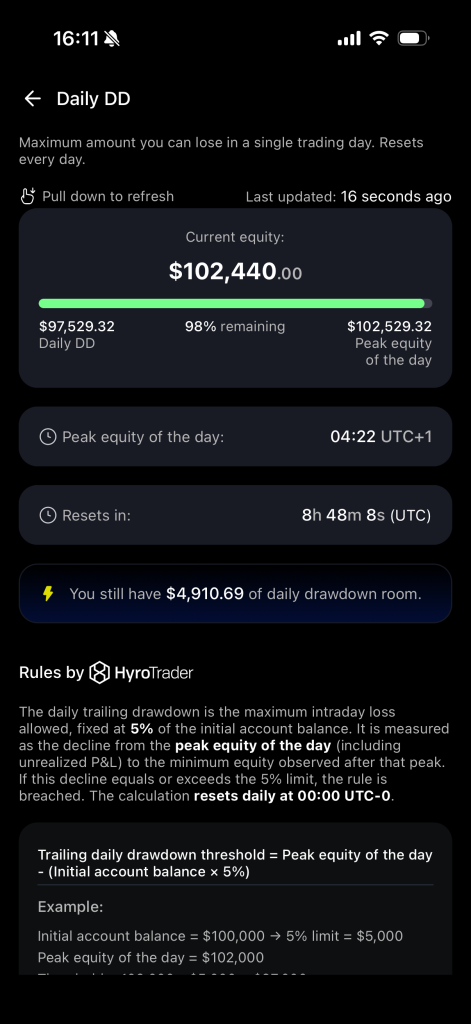
The CLEO mobile dashboard shows you your daily drawdown at a single click, anytime.
How to Stay on the Right Side of Daily Drawdown
There’s 5 things you need to do to become one of the rare traders to never breach their challenge’s daily drawdown.
1. Please read the challenge rules:
There’s many prop firms out there with just as many variations that profoundly change how prop firm challenges actually work. Read the FAQ, read every description they have to make sure you are not missing anything.
The best way to start is to do a Trial Challenge if they offer it. That way you’ll dispel any surprises or doubts you might have about the prop firm rules, process, or tech you’ll be using.
Never look at Backtesting or doing Challenge Trials as wasted time, especially when you’re starting out. If you can pass a challenge once, you can do it again. Confidence is your biggest trading edge.
2. Know Your Daily Drawdown:
If it sounds obvious…you’d be surprised. Before you place your first trade of the day, do one thing: check or calculate your breach level and then write it down.
Daily Drawdown Amount = Initial Account Balance × Drawdown %
Breach Level = Your Reference Point − Daily Drawdown Amount
Know exactly where that number is before you place any positions. Don’t even open the charts, it doesn’t matter what opportunities are out there if you don’t know where you stand in terms of drawdown.
3. Set a Personal Risk Limit:
Set your personal risk limit below the number you got in step 1.
Most experienced prop traders keep their personal daily cap at around half the firm's limit, giving themselves buffer for unexpected moves.
The reason for this is slippage, spreads and fees that may put you closer to the daily drawdown limit than you’d like. Even if your Stop Loss levels are perfect, where you get filled may come as a surprise, especially if you’re trading lower liquidity crypto pairs.
4. Your Trading Strategy Should be Built Around Daily Drawdown:
Any strategy you’re trading needs to be investigated for daily drawdown. You need to know your average drawdown and what possible extremes may happen. You do this through backtesting. Then you monitor if the performance matches your expectations.
Knowing your trading strategy can withstand daily drawdown limitations will give you confidence and make sure you follow the rules. This will save you from your mistakes.
5. Stick to One Trading Pair With High Liquidity:
If you’re just starting out you often receive the advice to trade only one pair. This is one of the reasons why. With 10 trading pairs any volatility will derail you suddenly and swiftly without a time to react.
When you’re trading only one pair and things are working you can start exploring a second. Confidence in your strategy will grow and when you execute, you will be able to follow your system.
Liquidity is crucial in prop trading, you want your orders to fill as close as possible to expectations. What you certainly want, is to decrease is the number of price spikes in either direction that will have you breach your account before you realize what’s going on.
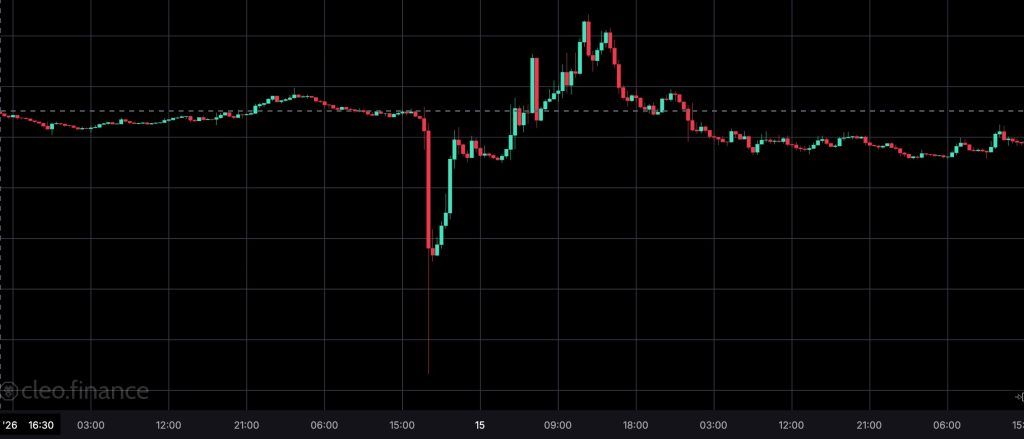
If you see wicks on the chart like above, avoid that asset.
Pass Your Trading Challenge
The traders who pass challenges consistently are not the ones who take the biggest positions. They are the ones who never get caught off guard by a rule they understood but did not track closely enough on a specific day.
Learn about all important rules in crypto prop trading.
Daily drawdown is not designed to punish you. It is designed to ensure that one bad day cannot end everything. Once you understand exactly how it works, it stops being a threat and starts being a framework that actually helps you trade with more discipline.