
You passed the challenge. You hit the profit target. You followed the drawdown rules to the letter. Then you got an email saying your account is closed.
Welcome to the hidden crypto prop firm rules that nobody mentions in the marketing.
The crypto prop trading industry has grown past $20 billion. Search interest has exploded 5,000% since 2020. New firms launch every month promising easy funded accounts, 80–90% profit splits, and instant payouts.
What often catches traders off guard is the myriads of rules that all these new firms employ. Even if you’ve gotten very cozy with the rules of one firm, when trading with another one there will be some variance that might surprise you. Surprises are not what you want in crypto prop trading.
Only around 7% of traders who start a crypto prop evaluation ever receive a single payout. Most didn't fail because of bad trading. They failed because of overlooking a prop firm rules they never knew existed.
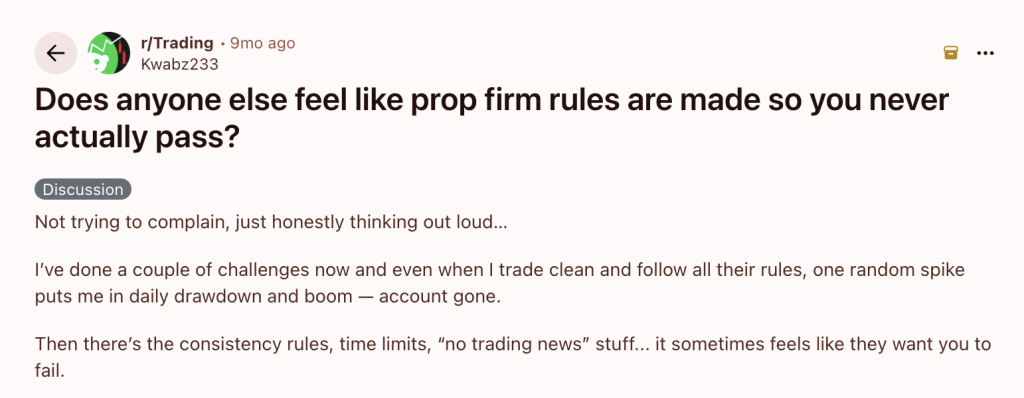
Source: Reddit
Here are the six hidden rules that matter most in crypto prop trading and exactly what to do about each one.
What Are Hidden Prop Firm Rules?
Hidden crypto prop firm rules are trading restrictions, payout conditions, and account termination triggers that are technically included in a firm's terms and conditions but are uncommon, specific to the firm or tend to trip up traders more than others.
They are "hidden" not because firms are breaking the law, most are technically disclosed somewhere, but because traders don’t see them, understand them or misinterpret them. They're not always the rules that cause traders to get breached most often.
In crypto specifically, these rules hit harder than in forex. Crypto markets run 24/7. Volatility is higher. Single sessions can produce outsized profits or losses that trigger rule clauses designed for slower markets. Understanding hidden prop firm rules before you buy a challenge is the most important research you can do.
Still, don't get hung up on the hidden crypto prop trading rules without understanding the most common ones.
Hidden Prop Firm Rule #1: The Consistency Rule
The consistency rule is one of the most damaging hidden prop firm rules in crypto, and not discussed enough.
Here is how it works. The rule limits how much of your total evaluation profit can come from any single trading session. The cap varies by firm but commonly sits around 25–30%. If your best day accounts for 45% of your total profit, the firm will at best increase your profit target. Some legacy firms have stricter penalties.
Picture this: you had a genuine edge, caught a clean breakout, sized up correctly, and booked 6% on the account in a single day. The evaluation gets voided. Not because you broke a drawdown limit, but because too much money came in on one day.
Why this hits harder in crypto: Crypto is event-driven by design. Protocol upgrades, ETF approvals, macro shocks, a tweet by a celebrity, and derivatives liquidation cascades create legitimate concentrated-profit opportunities that simply don't exist the same way in forex. A consistency rule designed to smooth out a forex trader's equity curve directly penalizes the exact strategies that generate edge in crypto.
How to handle it: Ask explicitly before purchasing any evaluation: "Does a consistency rule apply, and what is the maximum percentage of total profit allowed from one day?" Get a written response. A growing number of crypto-native firms have removed this rule entirely. Others have it but clearly state it and just move the profit target, instead of incurring a loss on the trader. If a firm can't give you a clear written answer, that is itself a red flag.
FAQ: What is the consistency rule in prop trading?
The consistency rule is a hidden prop firm rule that limits the percentage of your total profit that can come from any single trading day or position, typically 25–30%. Hitting your profit target is not enough if one day generated too large a share of it. This rule helps prop firms reward traders that can generate profit consistently, rather than getting lucky once or twice.
Hidden Prop Firm Rule #2: Trailing Drawdown Mechanics
Trailing drawdown is not a hidden prop firm rule, but worth mentioning as it tends to confuse beginner traders, and with good reason. The mechanics are genuinely counterintuitive.
Here is exactly how it works. You start with a $50,000 account and a 10% max drawdown. Your floor starts at $45,000. You trade well and grow to $55,000. The floor now trails up to $49,500. You give back some gains and drop back to $50,000, still net profitable. But your floor is $49,500 and your equity is $50,000. You have $500 of drawdown room remaining, down from $5,000 when you started.
We’ve written extensively about daily drawdown and still see confused users not understanding how it works. Especially the distinction between balance and equity.
A sequence of profitable days followed by one losing day can leave you with almost no risk room, even while you are in the green. In crypto, where Bitcoin can move 5–10% in a single session around a macro event and overnight wicks on altcoins are routine, trailing drawdown can terminate your account during your best trading month.
The hidden rule inside the hidden rule: Some firms trail drawdown on intraday equity. If a position runs in your favor to $52,000 before reversing to breakeven, your floor has permanently moved based on that unrealized peak, before you even close the trade. Other firms only move the floor at end-of-day (EOD trailing). The difference is enormous for any intraday strategy, and most firms don't specify which model applies in their headline terms.
How to handle it: Confirm in writing whether drawdown is static (fixed at starting balance for the life of the account) or trailing. If trailing, confirm whether it moves intraday on unrealized equity or only at day close. Static drawdown is structurally better for crypto traders: your risk buffer grows as the account does, rather than shrinking every time you have a good session.
Ideally you’d have a crypto prop trading platform that shows when the reset is happening so you don’t have to calculate as you make moves.
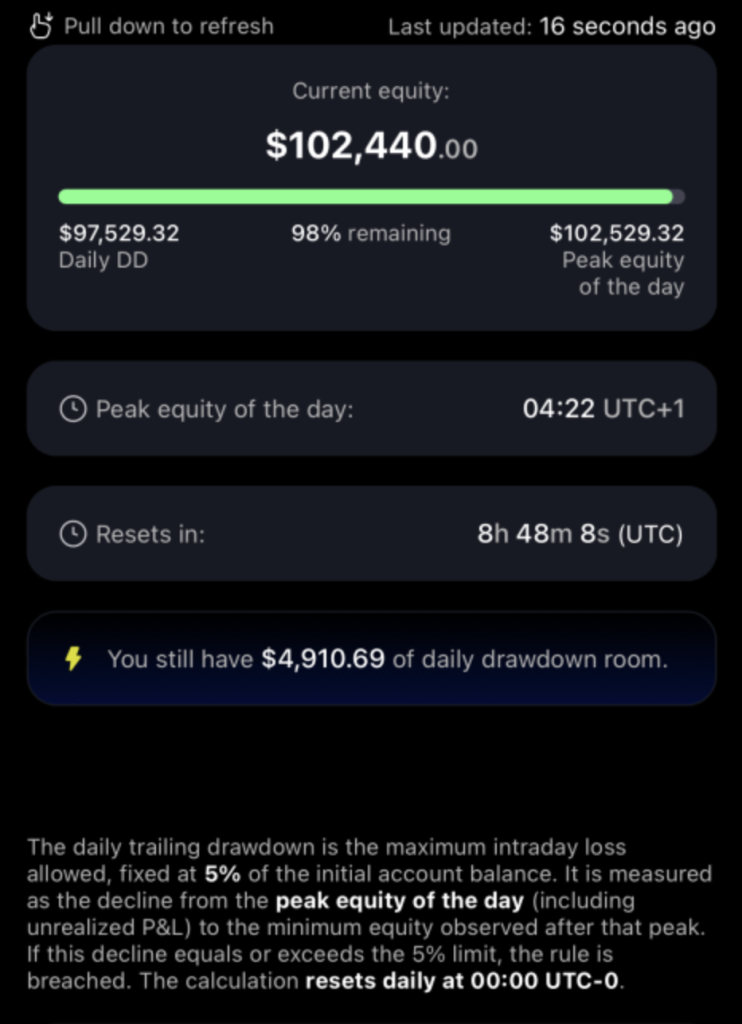
FAQ: What is trailing drawdown in a prop firm?
Trailing drawdown is a prop firm rule where your maximum loss floor moves upward as your account equity reaches new highs. Unlike static drawdown, which stays fixed at your starting balance trailing drawdown means profitable trading reduces your future risk tolerance. A spike to a new equity high, even on an unrealized intraday position at some crypto prop firms, can permanently tighten your drawdown room for the rest of the challenge.
Hidden Prop Firm Rule #3: Must Have a Stop Loss
All firms we’ve worked with have this stop loss clearly stated in the rules if they implement it and yet it routinely trips up trades. Some set it on 99 positions and on the 100th they forget. Others use multiple SLs and badly adjust them after a partial close. Accidents also happen, the trader removes the current one to set a new SL at a different price level and they get breached.
It’s not a bad rule to have permanently in your trading, but being covered a 100% of the time is a deeper obligation.
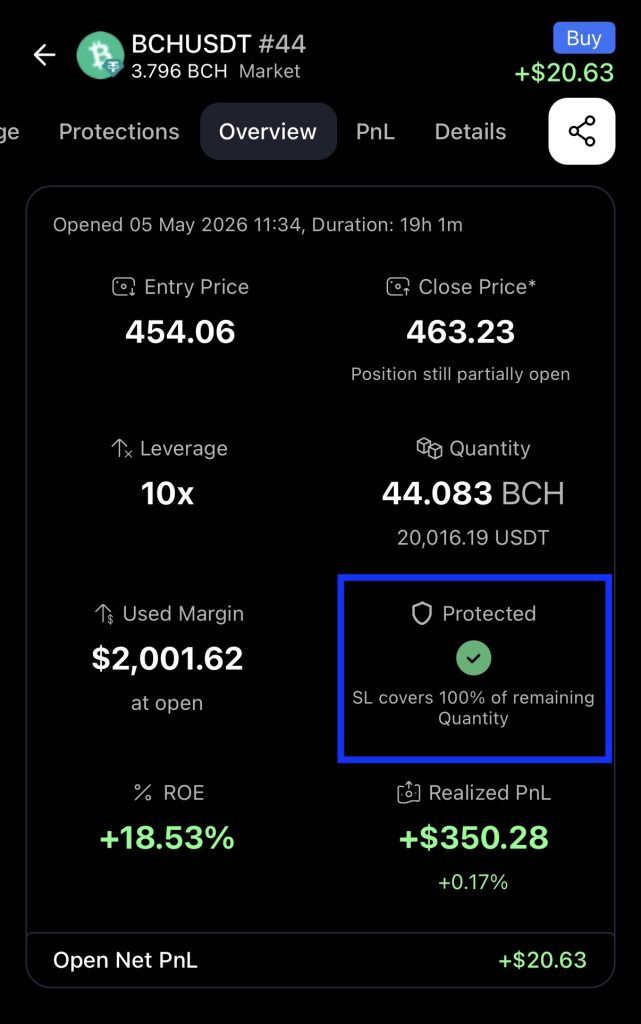
Know if your Stop Loss covers 100% of your position
How to handle it: Before starting understand if you can be without a stop loss even for a second. How can you change price levels? Make sure your trading platform clearly shows you if your SL covers 100% of your position at all times. If possible, use a crypto trading platform that has a Safe Mode where you confirm every trading action so you never remove your SL by accident. Better to click a few more times to confirm than have your account breached.
FAQ: What is the Stop Loss Rule in Crypto Prop Trading?
It means that you always must have a SL covering 100% of your position. It can be multiple SLs, you can change the price point, but it can be very unforgiving if you remove it even for a second.
Hidden Prop Firm Rule #4: The Impact of Trading Costs
Plenty of traders are shocked to see how trading costs actually play out once they have the Profit Target in their sights. We all know that trading involves funding fees, commissions and slippage, but how high they can be is not crystal clear. Exchanges rarely show this information in aggregate, and most traders don’t question what they get.
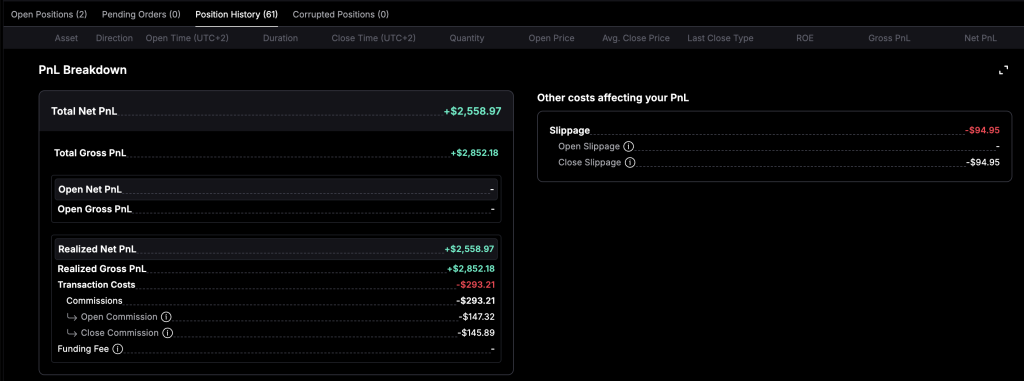
Full position costs breakdown in the CLEO Trading Platform
How to handle it: Before purchasing any trading challenge make sure that the prop firm uses real exchange liquidity and clarify what fee structure they employ. Ideally, they’d mimic what happens on the exchange (Bybit, Binance or another large one), so you don’t pay higher fees. Liquidity and spreads are also important as you don’t want to be exposed in artificially shallow markets.
To minimize slippage, stick to larger market caps. One wick on some illiquid pair can destroy your PnL, stop loss or not.
FAQ: What trading costs do prop firms have?
All regular trading costs like funding fees, trading fees and slippage apply crypto prop firm trading. The actual breakdown can sometimes be hidden or amplified by the way the prop firm is set up. Make sure you trade with crypto prop firms that simulate real liquidity.
Hidden Prop Firm Rule #5: Limits on Trading Small Caps
Similar to not being able to accumulate your profit from a single position or a day, some crypto prop firms also limit what percentage of profits can come from trading low cap altcoins. This rule does not come out of left field, low caps can produce outsized gains or losses.
Often you won’t be breached for trading these pairs, but again you will have gains eliminated and that can be a waste of time and effort.
Paired with slippage that hits harder on low caps, there’s really no reason to base your strategy on them.
How to handle it: Stick to larger caps. Limits volatility, you won’t get your profit target moved further or fall victim to slippage.
If you have experience and have been trading with the prop firm for a while you can start dabbling in lower caps. However, that confidence needs to come from a track record: that you can trade with slippage and volatility and that the prop firm will not penalize you.
FAQ: Can I trade low caps with crypto prop firms?
Some crypto prop firms limit what amount of your profits can come from small caps. Moreover, heavily trading them, makes you undertake more risk through slippage and volatility. Until you master the specific prop firm rules, stick to majors and build your strategy with high caps in mind.
Hidden Prop Firm Rule #6: Position Size Limitations: Stop Loss Size, Cumulative Position Size
Another rule aimed at limiting excessive risk that gets overlooked. Usually because traders think they’re not going to reach it. For example, Cumulative Position Size limits total exposure – all positions combined and is capped at something like 2x of account size. This may seem like a lot but at x10 leverage it involves just 20% of your margin used in positions at any moment.
The maximum Stop Loss rule can be sneaky when you’re in the flow. You’re setting your positions and not thinking too deeply when setting one wider Stop Loss. That SL amounts to more than 3% of your account and you’re breached and out.
The exact amount varies but it makes you operate on a tightrope. If you’re trading a $5000 account, you cannot place a SL more than $150 away. This applies to every single trade consistently, no second chances.
How to handle it: Make sure that your strategy is bult around position sizes that can handle these limitations. You have to consider position size AND Stop Loss distance and keep it consistent.
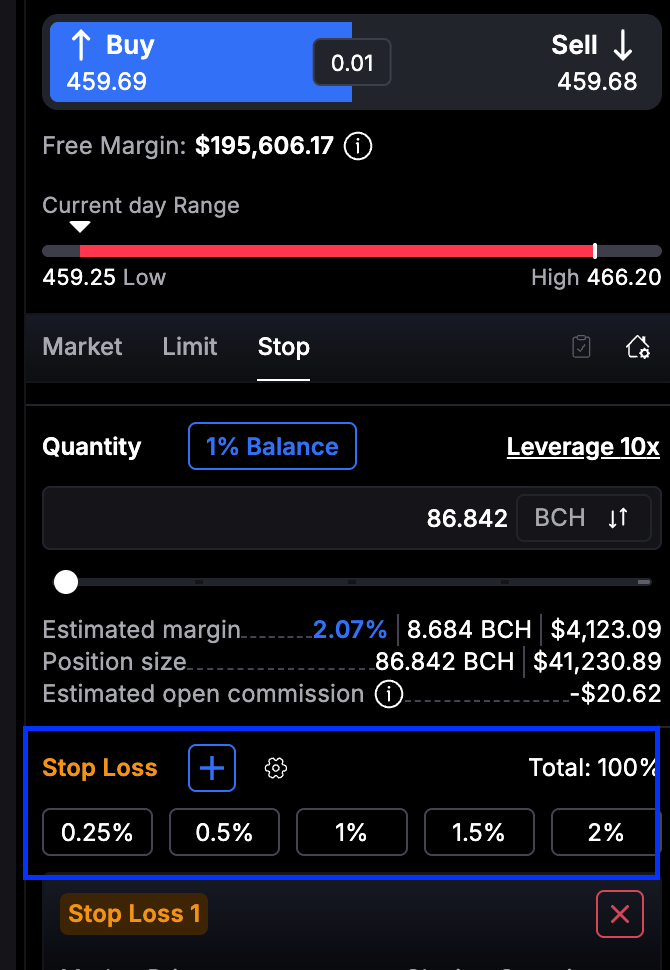
Order panel in the CLEO Trading Platform with Stop Loss presets
If possible, use a platform that has presets for placing protections, so you don’t have to spend mental energy on that.
Same thing for total exposure - stay on top of it religiously with tools that reveal it easily.
FAQ: #6: What are position size limitations: stop loss size, cumulative position size in crypto prop trading?
These are rules designed around position sizes and stop loss sizes that limit traders from having sizable exposure. They are framed for example: can’t have cumulative position value above 2x of account size or stop loss cannot be above 3% of account balance. Easy to forget when you’re trying to maximize opportunities.
Master Hidden Prop Trading Rules
It’s easy to blame prop firms for setting tough rules and the market for making it tough to function with them. As stated in the beginning, the issue here is not necessarily that the rules are hidden, just not publicized as much as key metrics.
At the end of the day, it’s your job to protect your capital and make sure you understand everything before buying a challenge. Demo accounts are a great way to trial prop firms as well.
Join the Discord, follow the social media accounts and go through the FAQs every time you start with a new firm. Don’t just donate your money.
Read everything. Ask about everything. Get answers in writing. Use trading platforms that help navigate crypto prop trading.
If you're just starting out with prop trading read our full guide to cover the basics and make sure you understand how things work before risking your funds.