
We analyzed position-level data across traders who passed their crypto prop firm challenge or moved to the next phase, and traders who got liquidated out of it. The point here is not to make judgements about individual calls or trade logic, but to see if there’s any behavioral lessons for traders that want to pass next time: what can you do differently on your next crypto prop challenge to pass?
We do have some findings that speak about a difference in habits. Passing traders were following a consistent, repeatable behavior pattern. Here is what it looks like, backed by the numbers.
This is part of an ongoing analysis of crypto prop trader outcomes. See our companion piece on why traders fail on day 1 for the failure-side data behind these numbers.
Passing Crypto Prop Traders slow down on day 1
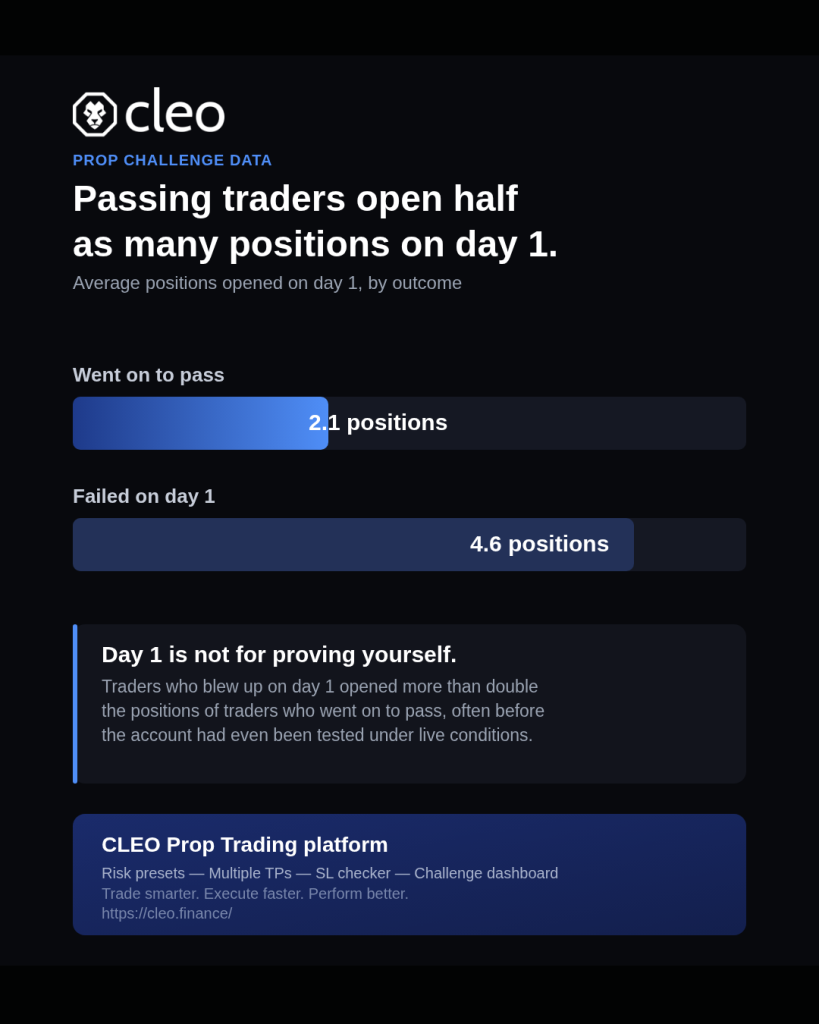
Passing traders opened an average of 2.1 positions on day 1, and that number is spread across their entire path to passing, showing more restraint as the challenge progresses. 29% did not open a single position on day 1.
Compare that to traders who failed on day 1: they opened an average of 4.6 positions before the account had even been tested under live conditions. Passing traders open less than half the positions on day one that failing traders do.
We’ll look deeper into traders who fail within the first 24 hours in the future so we can expand on this dataset.
There’s no point in rushing od day 1. Instead get used to the platform, the tools and keep practicing your process. It’s very unlikely that you’ll catch almost 5 excellent setups on day 1. Miss a few rather than opening bad positions and going into your drawdown.
Passing Crypto Prop Traders skip days on purpose
This is the clearest split in the entire dataset. Among traders who ultimately failed their crypto prop challenge, the ones who traded every single day failed in an average of 2.9 days. The ones who did not trade every day, who let days pass without opening a position, lasted 11.6 days before failing.
Passing traders take this further, seemingly knowing that not trading is a position too. It could be a sharper criteria or the ability to be more critical of developments in the markets. Either way we see a different ability in practicing restraint in traders who last longer in their challenge.

Passing crypto prop traders take their time
Median time to pass a challenge in this data was 13 days and the average is 23 days. One trader took five months. By contrast, the median time to fail was just 4 days. In fact, from those that fail in the first week 63% fail in the first 3 days.
Passing is not about speed, but it could be that minimum trading days are stressing some traders more than others. Passing a crypto prop firm challenge is about staying in the game long enough for your risk management to not breach drawdown, allowing your edge to show.
Daily drawdown is the #1 account killer in crypto prop trading. Opening more positions, faster will amplify possible breaches.
The traders who rush the process are the same traders who show up in the failure data days later.
Passing crypto prop traders keep position count low
On the day failing traders got breached, they had an average of 4.1 open positions running that day. The most extreme case had 22 positions open.
That’s terrible risk management resulting in correlated risk stacked across a dozen-plus tickets, where a single market move wipes out every position at once. Passing traders avoid this by keeping position count low enough that no single move against them ends the account.
We can quantify this as position velocity, positions opened per day survived:
- Passing traders: roughly 1.6 to 1.9 positions per day
- Failing traders: roughly 2.83 positions per day
Failing traders churn through setups at close to double the rate of traders who pass.
Passing crypto prop traders diversify where it counts
48% of passing traders traded a diversified basket of assets, compared to only 23% who stuck to a single asset. When passing traders did concentrate on one or two assets, BTC was the overwhelming favorite, the most liquid and most predictable instrument available.
Still the majority did tend to stick to more liquid assets preventing them from becoming victims of slippage and inefficient fills.
Diversification is not the whole story, but it fits the pattern. Traders who pass are spreading risk out across position count, timing, and asset selection, rather than concentrating it in any one place.
The playbook to passing a crypto prop challenge
If you strip out the noise, passing traders are running the same four habits:
- Open two positions on day 1, not five. Use the first day to observe, not to prove yourself.
- Skip days deliberately. Every day is not a trading day. Traders who force daily activity fail four times faster than those who don't.
- Cap your open position count. Four or more open at once is exactly where liquidations cluster in the failure data.
- Trade higher market cap assets. Nearly half of passing traders were not living or dying by a single instrument, but most of them concerned themselves with liquid assets.
None of this is about finding a better entry signal. It is about surviving long enough for your edge to actually show up in the results, while you stay above daily drawdown levels.
If you're just starting out with crypto prop trading read our full guide.