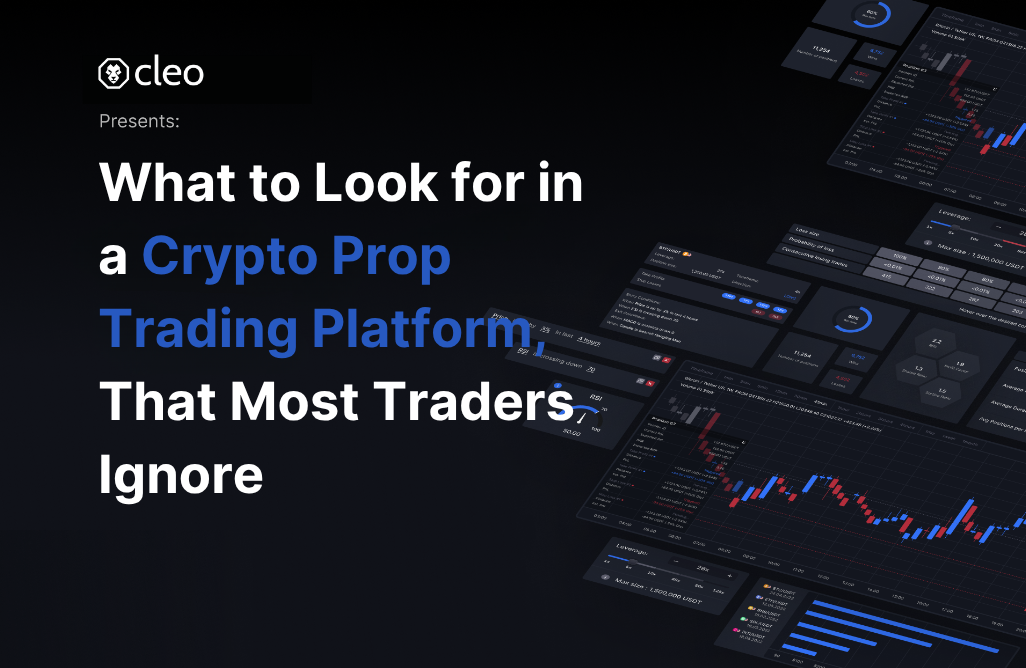
A crypto prop trading platform is not the same as a crypto prop firm. The crypto prop firm designs the challenge, rules and deals with funding, while the crypto prop trading platform is the executional layer on top of it. Plenty of traders don’t know the difference.
Many crypto prop firms offer trading on exchanges only, and this is a missed opportunity. A solid crypto prop trading platform does not only make you faster and better in the markets, it provides invaluable analytics and is another point of contact for you the trader. They can help with customer support and demonstrates that the prop firm is willing to include another layer of accountability in how they serve traders in terms of execution.
Most traders evaluate a prop firm on profit split, drawdown limits, and challenge price. Almost nobody evaluates the platform they will use to manage the challenge. That is backward and a missed factor that can lead to sucess.
The firm's rules are fixed before you buy the challenge. Your ability to stay within them, day after day, trade after trade, under pressure depends largely on your tools. Here is what to look for, and why most traders only figure this out after their first failed challenge.
1. Crypto Prop Trading Platform With Real Exchange Liquidity: You Are Trading Real Markets, Not a Simulation
Always check this with your crypto prop firm.
Many prop trading environments route your orders through a proprietary execution layer that simulates market conditions. Others don’t clarify if it’s Bybit, Binance, OKX as the data provider.
The difference matters in ways that are easy to underestimate until they hurt you. On a real order book, your fill price depends on what is actually available at your size. A $10,000 position on BTCUSDT perpetual fills cleanly. The same $10,000 on a thin mid-cap altcoin perpetual might eat through three or four price levels before your order is complete, leaving you with an average fill that is meaningfully worse than the price you saw when you clicked.
This is slippage and on a prop challenge, slippage does not just cut into your profit margin. It can push you through your daily loss limit on a single close, on a trade where your analysis was correct.
We see traders failing to account for slippage every day, entering massive position sizes and then failing to understand why their fill was not at the set market price.
Trading on real exchange liquidity means your results reflect real market conditions as close as possible. It also means the platform you use needs to be built for that environment, not for a simulation where fills are frictionless and price impact does not exist.
Not to mention that without transparency on data streams you have no clarity on spreads, liquidity and price can be potentially manipulated.
Everything else on this list is designed for traders operating in real market conditions. If your platform is not connecting you to real liquidity, most of these features matter less.
2. Real-Time Drawdown Visibility and Challenge Progress In One View
This is the most ignored feature in crypto prop trading platforms and the most consequential.
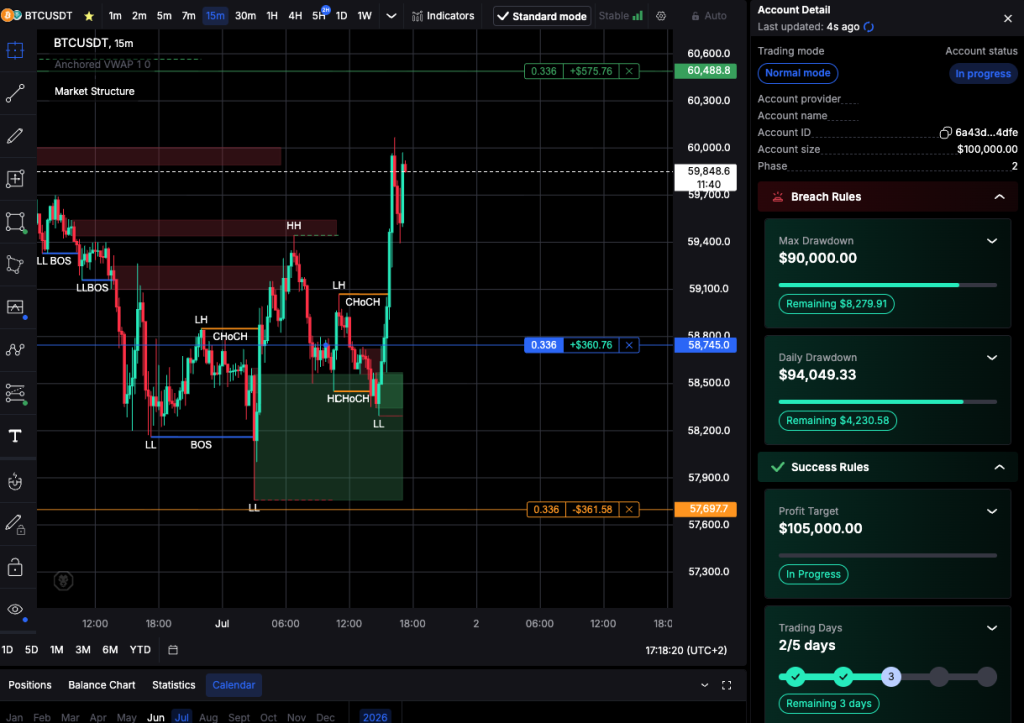
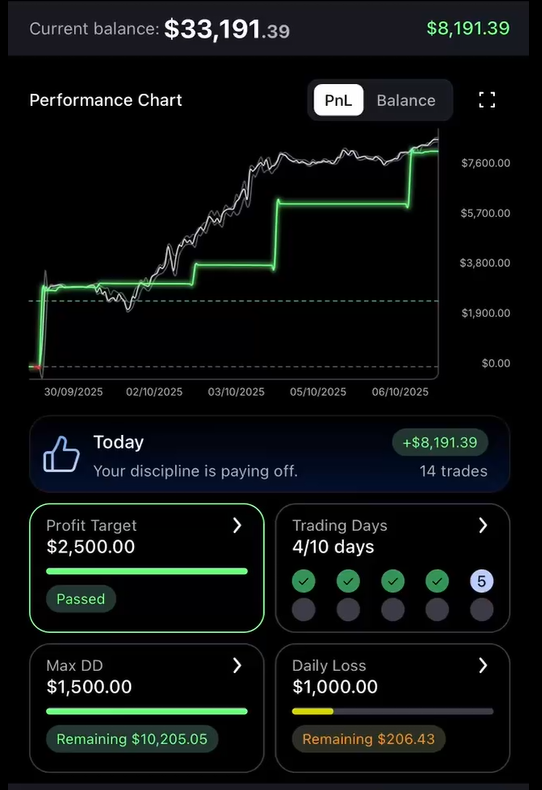
Most crypto prop traders check their drawdown manually, periodically, using their exchange balance and a rough mental calculation, or shift between the crypto prop firm dashboard and the exchange. That works until it does not and it usually stops working during a fast move, when your attention is on the trade, not the dashboard.
The first part of this problem is drawdown visibility. You need to know your current drawdown exposure in real time, updating continuously, not on refresh. The difference between knowing your drawdown at the start of a session and knowing it while a position is open against you is the difference between managing risk and watching risk going against you.
The second part is challenge progress. Prop firm challenges have multiple simultaneous targets running at once: hit the profit target, do not breach daily drawdown, do not breach max drawdown, meet minimum trading days if required. Most traders manage these across three separate places, the exchange dashboard, a spreadsheet, and their prop firm's dashboard none of which update in real time and none of which talk to each other. On top of it stare at the chart on a separate platform.
What you actually need is a single view that shows every challenge parameter simultaneously: profit target progress, daily loss remaining, max drawdown remaining, days traded. Not after the session, but during it. From that you should be able to swipe to your positions and their details.
When all of that information is visible in one place, you stop making decisions based on incomplete awareness of where you stand.
Knowing when your daily drawdown resets is crucial as well.
If you’re new to crypto prop trading rules, make sure you understand their nuances.
3. Pre-Trade Risk Calculation Right in Your Crypto Prop Trading Platform
Most risk calculators are external, built for retail traders managing personal capital. They calculate position size based on account balance and a stop loss percentage. That is not the same problem a prop trader is solving.
You want to be able to size based on fixed risk as well. “If I only want to lose $100 on this position at this price level, what position size do I go with?”
Those are three variables, not two.
What to look for is a crypto prop trading platform where you can really have your risk fixed as you consider positions. Being able to set a position where you use possible loss at that SL level as a % is very helpful as well. It does not matter if a position size is 0.5% or 50% of your account balance, what matters is how much are you risking through the potential loss if your SL gets hit.
4. Crypto Prop Trading Platform With Trading Statistics That Diagnose
An exchange gives you a trade history and some very basic numbers. That is not statistics, that is a log.
Statistics tell you whether your long bias is costing you on net, which sessions you consistently overtrade, what your average winner looks like versus your average loser, and whether your fee drag is large enough to affect your challenge viability.
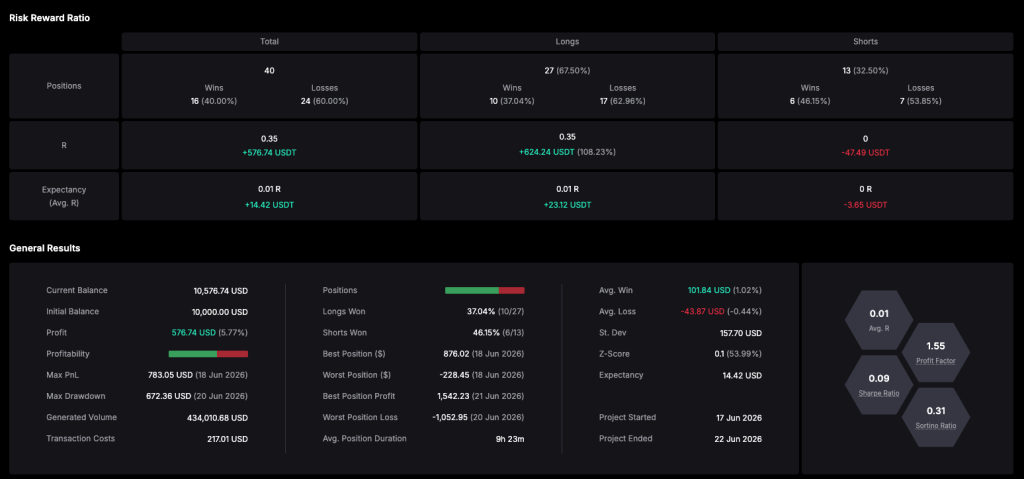
The distinction matters because a log requires you to do the analysis yourself. Statistics surface the pattern without you having to look for it.
Traders often get advice to “study every loser,” but that’s redundant. You need to see what is wrong and when you make the mistakes.
You should not need to spend an hour in a spreadsheet to find out that your short trades underperform your long trades by 18 percentage points, or that 60% of your losing trades happen in the two hours before the New York close or weekends.
What to look for in your crypto prop trading platform: win rate broken down by direction, by session, by asset. Average risk/reward on winners versus losers. Fee impact as a percentage of gross PnL. Overtrading patterns by day and time. These are the metrics that tell you what to change. Without them you are guessing, and guessing is expensive when you are operating under hard loss limits.
Solid trading statistics can fix your trading performance in minutes.
5. A Performance Calendar That Surfaces Behavioral Patterns
Per-trade statistics tell you what happened. A performance calendar tells you when it keeps happening. That is a different and often more useful insight. and essential to a good crypto prop trading platform.
Knowing your win rate is 54% does not tell you that you lose consistently on Mondays, overtrade on Fridays, or that your worst drawdown days cluster in the first week of every month. Those are behavioral patterns, not market patterns. They only become visible when you map your PnL across time rather than across individual trades.
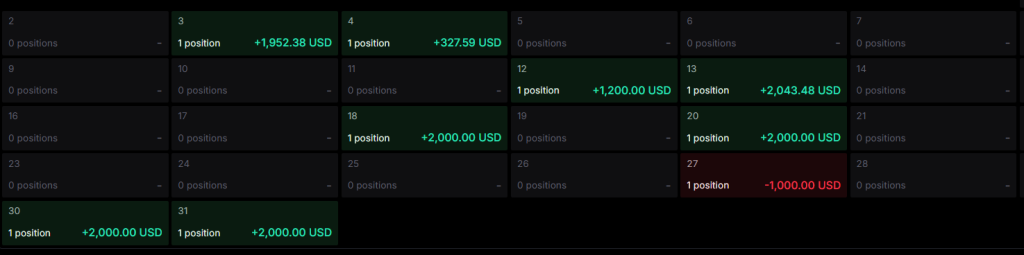
What to look for is a calendar view of daily PnL that lets you scan across weeks and months visually. The patterns you are looking for are not always obvious in a table but become obvious the moment you see three consecutive red Mondays on a grid. Once you see it, you can act on it: reduce size on historically weak days, skip certain sessions entirely, or at minimum go into those days to check the logic behind the positions.
On a prop challenge this matters more than it does on a personal account. You do not have unlimited days to run a behavioral pattern into the ground before you figure it out. Identifying it early can be an account saver.
6. Multiple Take Profit Targets Per Trade
Serious prop traders do not close positions at a single take profit level. They scale out in tranches, taking partial profit at the first target, letting the remainder run to a second or third level, and managing the stop on the residual position as the trade develops.
This saves you from entering new positions and piling up potential drawdown.
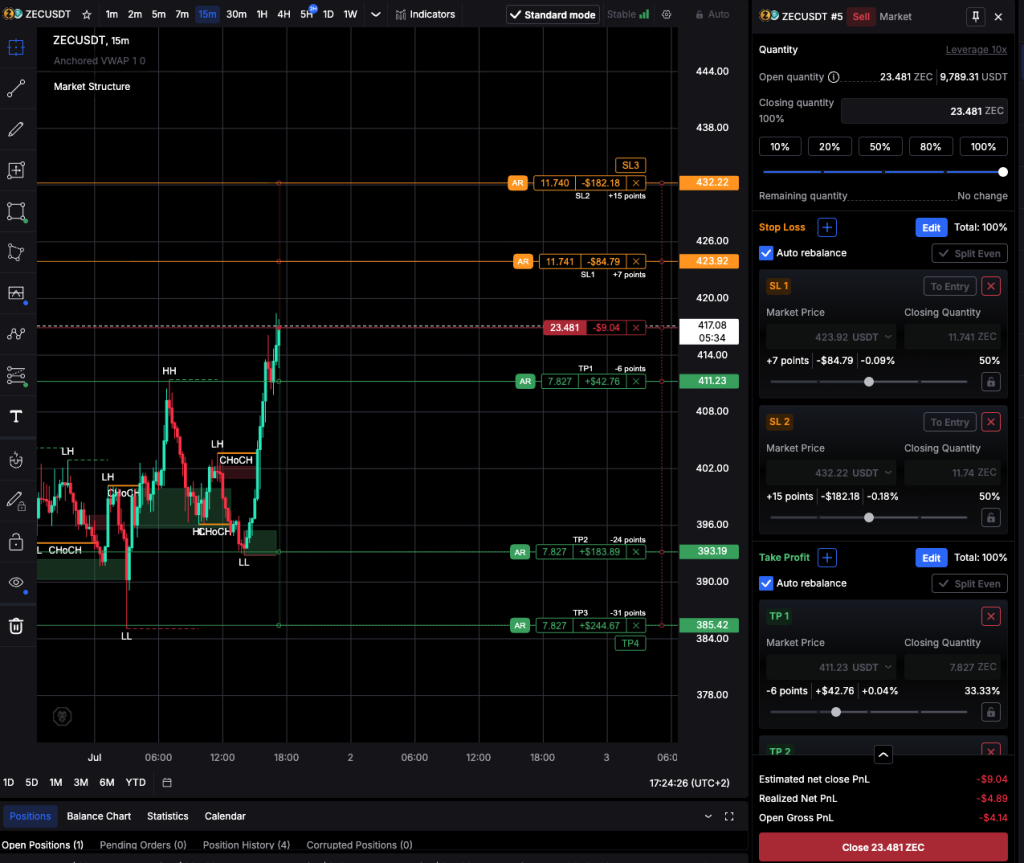
On a standard exchange interface, this means manually placing and adjusting multiple orders mid-trade. That introduces execution error: you are modifying orders at the same time you should be watching price action and cannot plan in advance. It causes impulsive decisions that are often the culprit behind account breaches.
The right approach is to define your full exit plan before the trade is open. Entry, stop, TP1 with size, TP2 with size, TP3 with size, move SL to Entry, move SL in Profit, all placed and automated before the move happens. Your job then is to watch, not to act.
What to look for is a platform that supports multiple take profit levels per trade with defined size at each level, configured at entry rather than managed manually as the trade develops. This is standard practice for professional traders and almost entirely absent from exchange-native interfaces.
7. Visual Trade Execution, Because Speed Maters
Most traders place orders through a form. A price field, a size field, a button. That interface tells you nothing about where your entry sits relative to recent structure, where your stop is in relation to liquidity, or how your take profit levels are distributed across the range of the move.
Plus, they are transcribing from their analysis on a charting platform to an exchange. Errors can certainly happen.
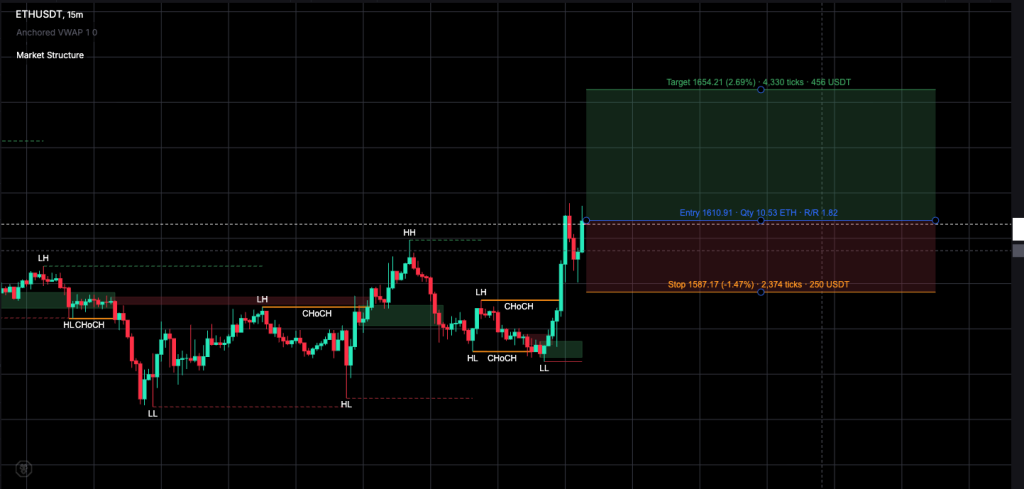
Visual trading changes that. Placing a trade directly on the chart: dragging your entry, stop, and take profit levels onto price forces you to think in market structure terms rather than number terms. Your stop is not "-1.2%", it is below that swing low. Your take profit is not "+2.4%", it is at the previous high. The difference sounds subtle, but it materially changes how traders plan and manage positions.
On a prop challenge this has a second benefit: it makes your risk visible before you commit. When you can see your stop loss distance and your take profit targets drawn on the chart simultaneously, the risk/reward relationship is immediate and spatial rather than calculated after the fact. Traders who plan visually tend to enter with more conviction and adjust less mid-trade both of which matter when you are operating under hard daily loss limits and every unnecessary intervention costs you.
What to look for is a crypto prop trading platform where you can place and adjust orders directly on the chart, with real-time PnL and drawdown impact updating as you move levels around.
Why Your Crypto Prop Trading Platform Matters More on a Prop Challenge Than on a Personal Account
On a personal account, bad tools costs you efficiency. You might miss a take profit level, go for a trade at a bad size, or fail to notice a behavioral pattern until it has cost you several weeks of performance. You can absorb that and keep trading.
On a prop challenge, it costs you the challenge. The rules are fixed. The loss limits are hard, especially daily loss. Every feature on this list exists to reduce the gap between what you intend to do and what executes and that gap is where most challenges are lost. Not in analysis, not in strategy, but in execution, in awareness, and in the behavioral patterns that only become visible when you have the right tools to surface them.
Trading is about boring repetition, if you can’t customize the trading environment to provide you that, it’s not the best possible environment.
CLEO is a crypto prop trading platform built specifically for prop firm challenge traders. Real-time drawdown tracking, multi-target take profit, performance statistics and calendar, and visual trade execution. It’s the first platform created for crypto prop traders.