
There's an account breach mental error pattern we keep seeing at CLEO that almost nobody in the crypto prop trading space talks about openly.
Of the traders who fail their first challenge in the first week, 30% fail on day 1. Not day 5. Not after a bad few days. Day 1. More first-day failures than on any other day in the first week.
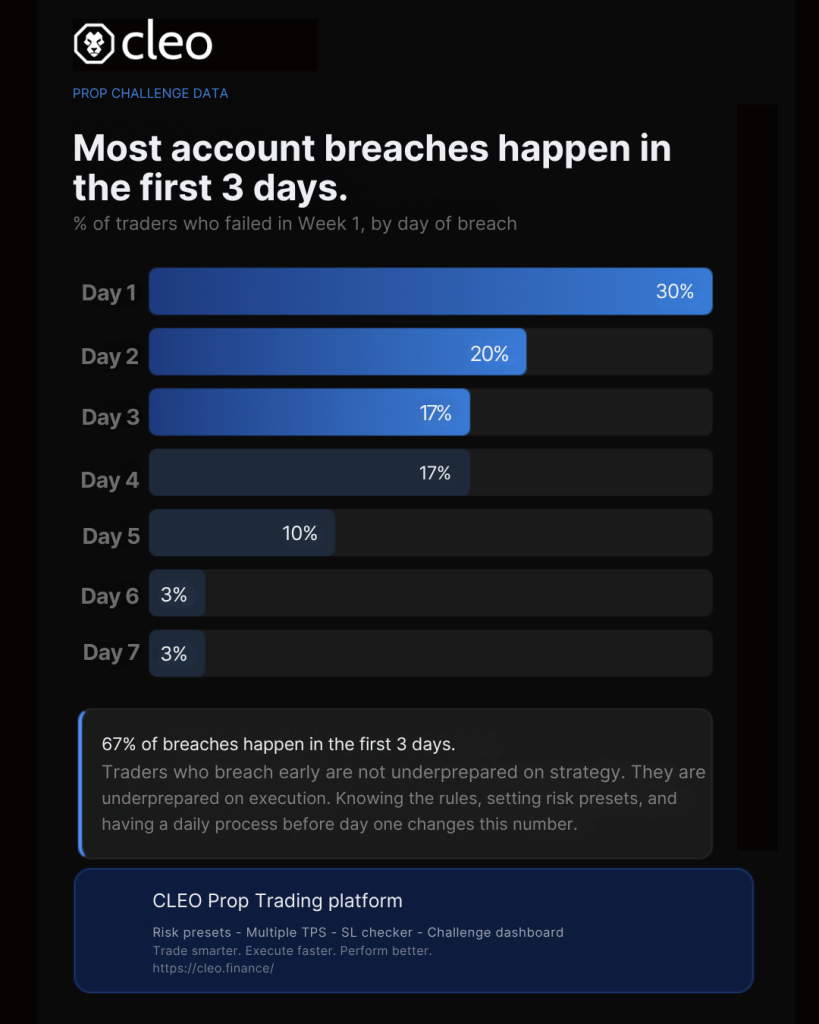
And when we looked closer at how those failures happened, the story was almost identical every time. They bought the account, they opened the platform. They started placing trades. Almost none of them waited at all. Nobody failed on position #1, everyone went guns blazing within the first 24 hours.
That's not a strategy problem. That's something else entirely and if you understand what it is, you can avoid becoming that statistic before you even begin.
The Gap Between Buying a Trading Challenge and Being Ready
There's a specific psychological state that occurs the moment a trader purchases a challenge account. The money has been spent and the account is live. The clock, in their mind, has already started even though no rules have been breached and no positions have been placed.
What follows is a pressure that has nothing to do with the market. It's internal. A funded account feels like an obligation the moment you own it and sitting idle feels like falling behind.
This is the trap. And it's entirely manufactured.
The challenge has no rule that requires you to trade on day 1. The drawdown limit doesn't care whether you've placed one trade or fifty. The only thing that's changed is your sense of urgency.
What the Data Actually Show About Traders Breaching Their Challenge
Looking at first-day failures across challenge accounts on CLEO, two patterns account for nearly every case:
Overtrading. Not a single trader who failed on day 1 placed only one position. Every account that was breached on the first day had multiple trades, often many more than the trader's own stated system would call for. In the absence of a clear setup, they created activity, activity became size. Which finally turned into a breach.
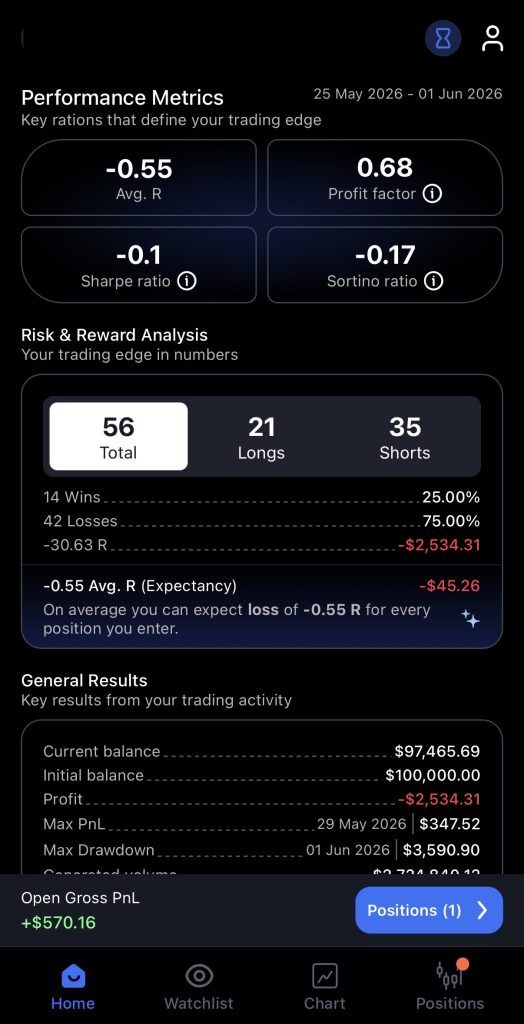
Overtrading in action
No waiting, scanning or planning. Almost without exception, the traders who failed on day 1 went straight from purchase to trading. No review of the rules. No mapping of their system to the challenge parameters. No identification of what a valid setup looks like under the specific conditions of that account. They opened the platform and started.
Why Does Overtrading Happen and Why It's Not About Trading Discipline
It would be easy to frame this as a discipline failure and move on. But that framing isn't useful and it isn't accurate.
The traders failing on day 1 are not undisciplined people. Many of them could have been trading for years. What's happening is something more specific: the act of purchasing an account changes their relationship to inactivity.
In their normal trading environment, not trading on a given day is neutral. It's a choice that carries no weight. But the moment there’s a challenge to their name, sitting idle starts to feel like losing even though no rules have been touched and the account is perfectly intact.
Crypto carries plenty of volatility and this is proven to be one of the factors that contribute to taking more trades.
This is compounded by what behavioral research on FOMO tells us: social media will make it harder for you to be idle. Once the traders bought the accounts, what they read others doing ,becomes triggering.
It could also be that these traders saw an opportunity and bought the account for it. Which did not pan out positively, implying that seeing one setup will make you see more where they are none.
What Waiting When Trading Actually Looks Like in Practice
Waiting doesn't mean staring at charts and resisting. Traders who navigate day 1 well aren't white-knuckling their way through it. They've structured the day so that trading isn't even the available option yet.
Before placing a single position on a new challenge account, there are concrete things that you must do(!):
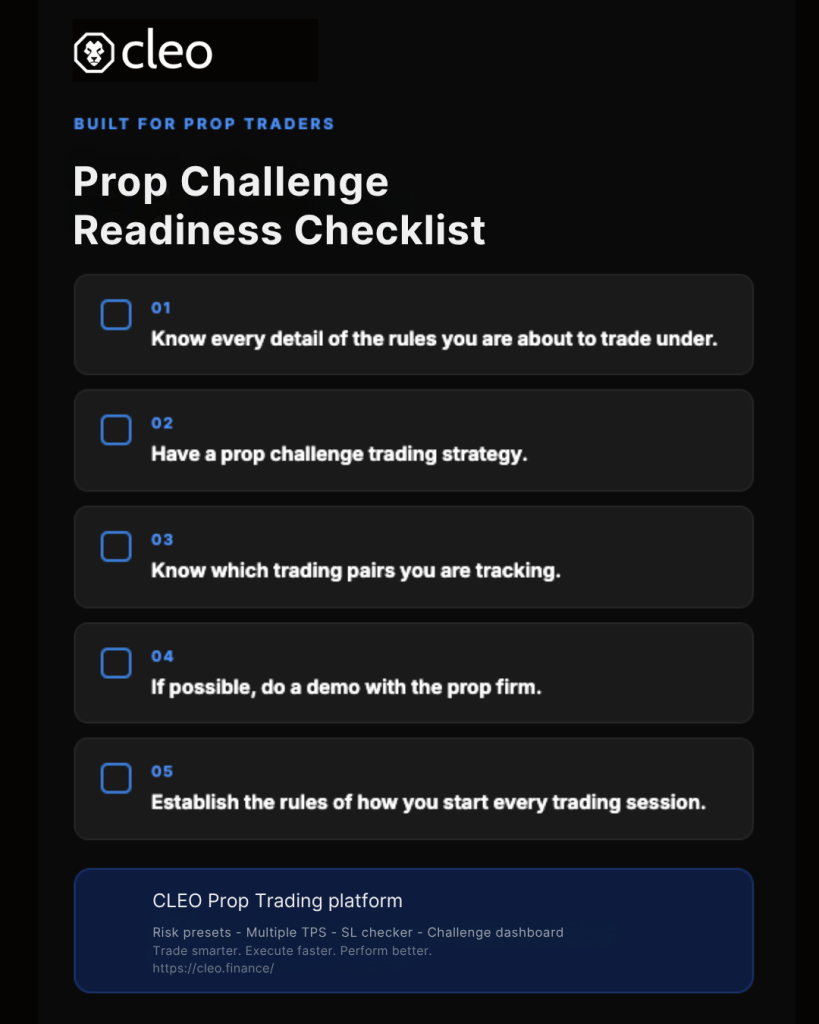
- Know every detail of the rules you’re about to trade under. Is daily loss trailing? What’s the size of PnL you must achieve before the trading day counts? Is there max stop loss per position allowed? If you're new to crypto prop rules, you need to master the details.
There’s many prop trading rules and you need to master each. Even the sneakier “hidden” ones. - Have a prop challenge trading strategy. Entry/exit, position size, risk per position, allowed number of active positions. This should be based on backtesting and should be the source of your confidence. You’d have data where you know what performance you can expect: average position length, winning/losing streak and number of trades per day/week.
- Know which trading pairs you’re tracking. Relating to your backtesting, you have data on these pairs and know what to expect.
- If possible, do a demo with the prop firm, some prop firms that feature CLEO allow this. It will help you see how you perform within the rules and see how it feels to execute your strategy.
- Establish the rules of how you start every trading session. Scan markets first or review results? Social media on or off? Which charts will you look at exactly? How much time will you spend on this? Do you check in or let it run?
Accept that day 1 may not offer a valid setup. This is the part that's hardest to sit with, and it's the most important. Your system doesn't produce setups on demand. The market doesn't care that you bought an account today. There is a meaningful probability, depending on your strategy and the market conditions that nothing valid will appear on day 1. That's not failure. That's the job.
If you feel overwhelmed by going through everything you need to be ready for, start planning for prop firm success from the beginning.
The Structural Advantage You're Not Using to Pass a Crypto Prop Challenge
One of the things a prop challenge does, if you let it, is enforce the kind of discipline that's genuinely difficult to maintain when it's your own capital on the line with no one to be punitive for mistakes. The rules do protect the firm, but they also set a structure that most retail traders never have and never build for themselves.
That structure only works if you engage with it intentionally. Most traders treat the challenge rules as constraints to navigate around. The traders who build long-term funded accounts treat them as a framework to trade inside.
Setting up your CLEO account before you begin trading means configuring your parameters to match your actual system. Your typical session length. Your realistic trade frequency within the rules where you’re trading. The setups your strategy genuinely calls for, not the ones you take when you're bored or feel FOMO.
Use presets to set risk per position. Calculate potential daily loss before you enter anything. You need a plan on how you'll master daily drawdown in particular.
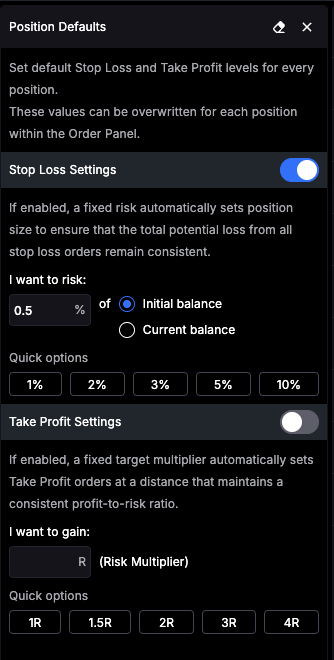
Decide if you use the app to place trades, modify them or only monitor. The challenge dashboard is a magnet for repeated checks, but you need to decide if it’s doing you good or harm. Same thing for the charts when you’re away from your desk.
Before Your First Trade
If you've just purchased a CLEO challenge with ANY crypto prop firm, or you're about to, here's the practical sequence worth following before you place anything:
- Be super comfortable with the 5 points above. Check the dashboard and make sure you follow your progress there as you trade.
- You have your specific strategy conditions written down. Look at the current market structure and ask honestly whether those conditions exist today. If they don't, close the platform.
- There's a reasonable chance the right trade isn't available on day 1. There's a very high chance it will be available later in the week. The account will still be there. The rules will still be intact. And you'll be starting from a position of patience rather than recovering from a position of damage.
The traders who make it through challenges aren't the ones who found the best setups on day 1. They're the ones who had nothing to recover from by day 2.